 Lynden Window
 Asphalt Shingle Roofing in Custer: A Whatcom County Crew That Already Works This Ground
Custer sits in the open agricultural flatland north of Ferndale, close enough to the Salish Sea that salt air and heavy marine weather still shape how a roof needs to be built out here, even though it isn't a true waterfront community. Storms roll in off the water with little to break them across the open fields, driving rain sideways into roof valleys and under any flashing that isn't lapped correctly. Add in Whatcom County's mild, wet winters and you get a moss season that can run most of the year on shaded or north-facing roof slopes. Asphalt shingle roofing has to be chosen and installed with all of that in mind, not picked off a sample board and nailed down to bare code minimums.
Lynden Window Co works roofs, siding, and windows throughout this part of Whatcom County, and Custer is regular territory for us, not a stretch assignment. On asphalt shingle roofs specifically, that means we treat underlayment, flashing, and ventilation as being just as important as the shingle on the invoice — because in this climate those are the details that actually decide whether a roof lasts its full rated life or starts leaking a decade early.
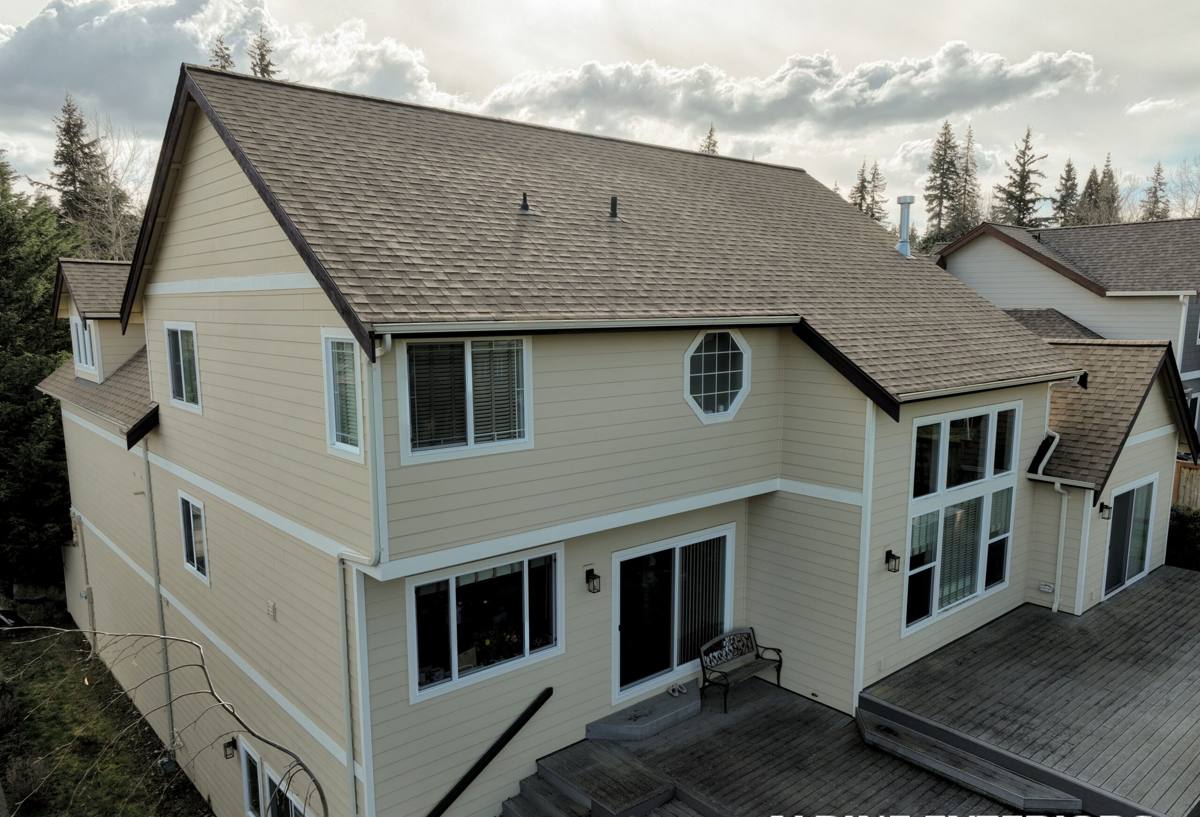
What Salt Air, Driving Rain, and a Long Moss Season Do to a Custer Roof
Wind-Driven Rain Across Open Farmland
There isn't much to slow wind coming off the water and across the flat, open fields around Custer. That means rain often hits a roof at an angle instead of falling straight down, and it finds its way into valleys, around vent pipes, and under shingle edges that a calmer, more sheltered site would never test. Flashing and underlayment do most of the real work here — the shingles are the visible layer, but the waterproofing underneath is what actually keeps a roof dry through a sideways storm.
Salt-Tinged Marine Air
Custer doesn't take the direct salt spray a true waterfront property does, but it sits close enough to the Salish Sea that salt-laden air still reaches it, especially during winter storms. Over years, that air accelerates corrosion on lower-grade fasteners, flashing, and any exposed metal roofing components. It's a slower, quieter form of wear than wind or moss, but it eventually shows up as rust streaks, failed sealant, and fasteners that no longer hold as tight as they should.
A Moss and Algae Season That Doesn't Really End
Mild temperatures and near-constant moisture give moss and algae a long growing season across Whatcom County, and asphalt shingles are a favorite surface for both. Shaded roof planes, north-facing slopes, and anywhere debris collects in a valley hold moisture longest and moss takes hold fastest. Left unchecked, moss doesn't just look bad — it lifts shingle edges, holds water against the roof deck, and shortens the roof's usable life well before it would otherwise need replacing.
Temperature Swings and Shingle Fatigue
Whatcom County doesn't see harsh extremes most years, but the steady cycle of damp, mild days punctuated by cold snaps still stresses asphalt shingles over time. Shingles that stay saturated more often than they get a chance to fully dry age faster than the same product would in a drier region, which is part of why material choice and installation quality matter more here than they would in a simpler climate.
Choosing an Asphalt Shingle for This Climate
Not every asphalt shingle is built with the same priorities, and for a Custer roof, moss resistance and wind performance matter more than they would on a sheltered, tree-covered lot in a milder climate. Here's how the common tiers compare:
| Shingle Type | Moss & Algae Resistance | Wind Rating | Typical Lifespan Here |
|---|---|---|---|
| Standard 3-tab | Basic; no algae-resistant granules unless specified | Lower; more vulnerable on open, wind-exposed lots | 15-20 years |
| Architectural (laminated) | Good, especially with algae-resistant granule options | Higher; better suited to Custer's open exposure | 20-30 years |
| Premium/designer architectural | Best available in asphalt, with heavier algae-resistant granules | Highest asphalt-tier rating | 25-30+ years |
For a wind-exposed, open site like most Custer properties, we generally steer homeowners toward architectural shingles with algae-resistant granules as the baseline, not an upsell. The cost difference over a standard 3-tab shingle is modest relative to the total job, and the added wind rating and moss resistance matter more here than they would on a sheltered lot farther from the water.
What a Correct Asphalt Shingle Install Actually Involves
The shingle itself is only part of the system. On every asphalt shingle roof we install in Custer, the following are standard practice, not optional add-ons:
- Underlayment rated for sustained moisture exposure, not a bare-minimum code product
- Ice-and-water shield at eaves, valleys, and other spots where water and debris collect
- Properly lapped and sealed flashing at every valley, chimney, vent pipe, and roof-to-wall transition
- Corrosion-resistant fasteners and flashing metal suited to salt-tinged marine air
- Balanced attic and roof deck ventilation that lets trapped moisture escape
- A nailing pattern that meets the shingle manufacturer's wind-rating requirements for this exposure, not just the local code minimum
None of these add significant cost relative to the shingles themselves, but skipping any one of them is exactly what turns a twenty-five-year roof into a fifteen-year roof out here.
Roof Ventilation: A Small Detail With Big Consequences
Getting the Ridge-to-Soffit Balance Right
A roof needs intake ventilation at the eaves and exhaust ventilation near the ridge working together, in roughly the right proportion, for air to actually move through the attic instead of just sitting there. On older Custer homes we often find one side of that equation missing entirely — soffit vents painted shut or blocked by insulation, or a ridge vent added without enough intake to feed it. Half a ventilation system barely functions better than none at all.
What Trapped Moisture Does From Underneath
An asphalt shingle roof takes moisture from above in this climate, but a poorly ventilated attic adds moisture pressure from below, from everyday household humidity that has nowhere to go. Over time that shows up as premature shingle aging, damp roof sheathing, and in colder stretches, condensation on the underside of the deck. It's a slower-moving problem than a leak, but it's one that ventilation corrections and proper installation prevent from the start rather than fix after the fact.
Signs a Custer Roof Needs a Closer Look
- Moss returning quickly in valleys or on shaded slopes after cleaning
- Granules collecting in gutters or piling up at the base of downspouts
- Curling, cupping, cracked, or missing shingles, especially after a windstorm
- Water staining on interior ceilings near exterior walls or around chimneys
- Rust streaks or visibly failing sealant around flashing and vent pipes
- Soft spots or noticeable sag anywhere on the roof when it's walked
Any one of these is worth a professional look before the next wet season sets in. Caught early, most of them are a repair. Left alone through another winter of driving rain, several of them tend to compound into a full replacement.
Repair or Replace: How We Help You Decide
We don't default to recommending replacement just because it's the bigger job. What actually matters is the roof's age relative to its rated life, how much of the surface is affected, whether the deck underneath already has moisture damage, and how many repairs the roof has already had. A localized leak on an otherwise sound roof is usually a straightforward repair. A roof nearing the end of its life with moss-related damage spread across multiple slopes, or soft spots in the deck from long-term moisture, is usually addressed more honestly with a replacement than another patch that only buys a season or two. We'll walk you through what we find and why, and lay out the real trade-offs instead of steering toward whichever option happens to pay better.
Our Process on Custer Asphalt Shingle Roofing Jobs
Inspection and Written Scope
We start with an on-site inspection — checking shingle condition, flashing, ventilation, and signs of moisture at the deck — before recommending anything. From there you get a written scope that spells out materials, underlayment, flashing detail, and timeline, so there's no ambiguity about what's included and what isn't.
Tear-Off and Deck Check
On replacement jobs, tear-off and a full deck inspection happen first. Any rot or moisture damage hidden under the old shingles gets identified and addressed before new material goes down, rather than covered up and left to surface again in a few years.
Installation and Final Walkthrough
Ice-and-water shield, properly lapped flashing, and balanced ventilation are handled as standard practice on every job, not offered as optional upgrades after the fact. When the work is done, we walk the job with you and go over what was installed and why, so you know exactly what's now protecting your home.
Why a Crew That Already Works Custer Matters
A crew that roofs this specific stretch of Whatcom County through every season sees firsthand how salt air, driving rain, and a long moss season actually behave on real houses over years, not just how a shingle performs on a manufacturer's data sheet. That shows up in practical, job-day decisions: how much ice-and-water shield a given valley actually needs on an open, wind-exposed lot, which flashing details are worth the extra time so you're not dealing with a leak two winters later, and when fasteners or flashing metal need to be upgraded for the marine air that reaches this far inland. It also means showing up already knowing the difference between a wind-exposed farmland roof and a sheltered, tree-covered one, instead of applying the same approach to every job.
Roofing is one piece of what Lynden Window Co handles for Custer homeowners — we also do windows, siding, and general exterior work, and we think about them as connected rather than separate jobs. A roof project that turns up moisture damage at a wall-to-roof transition, or aging trim near a chimney, doesn't have to become a second contractor's problem. We can address it as part of the same conversation, with the same crew that already understands how this property's roof, walls, and windows are supposed to work together against this climate.
If your Custer roof needs an inspection, a repair, or you're weighing a full replacement, we're glad to take a look and give you a straightforward, honest read on what it actually needs — no pressure, no upsell script. Reach out using the form below to schedule a free estimate.