 Lynden Window
 Siding Repair in Acme: A Whatcom County Climate Problem, Not Just a Cosmetic One
Acme is a small, tree-covered community in the Whatcom County foothills, and homes out here take on weather differently than a house in downtown Lynden or out on open farmland. Heavier tree cover means more shade, slower drying, and more organic debris landing on siding and staying there. Add in the marine-influenced weather that defines this whole corner of Washington — damp, salt-tinged air moving in off the Sound, driving rain that comes in sideways during winter storms, and a moss season that can run eight months out of the year — and you get siding that ages faster than the manufacturer's brochure suggests. Siding repair here isn't about touching up a paint chip. It's about stopping water and organic growth from doing structural damage before it gets expensive.
We treat siding repair as a diagnostic job first and a cosmetic job second. A crack, a soft spot, or a stain is a symptom. Our job is to find what's causing it, fix that, and then restore the surface — not just cover the symptom and move on to the next house.
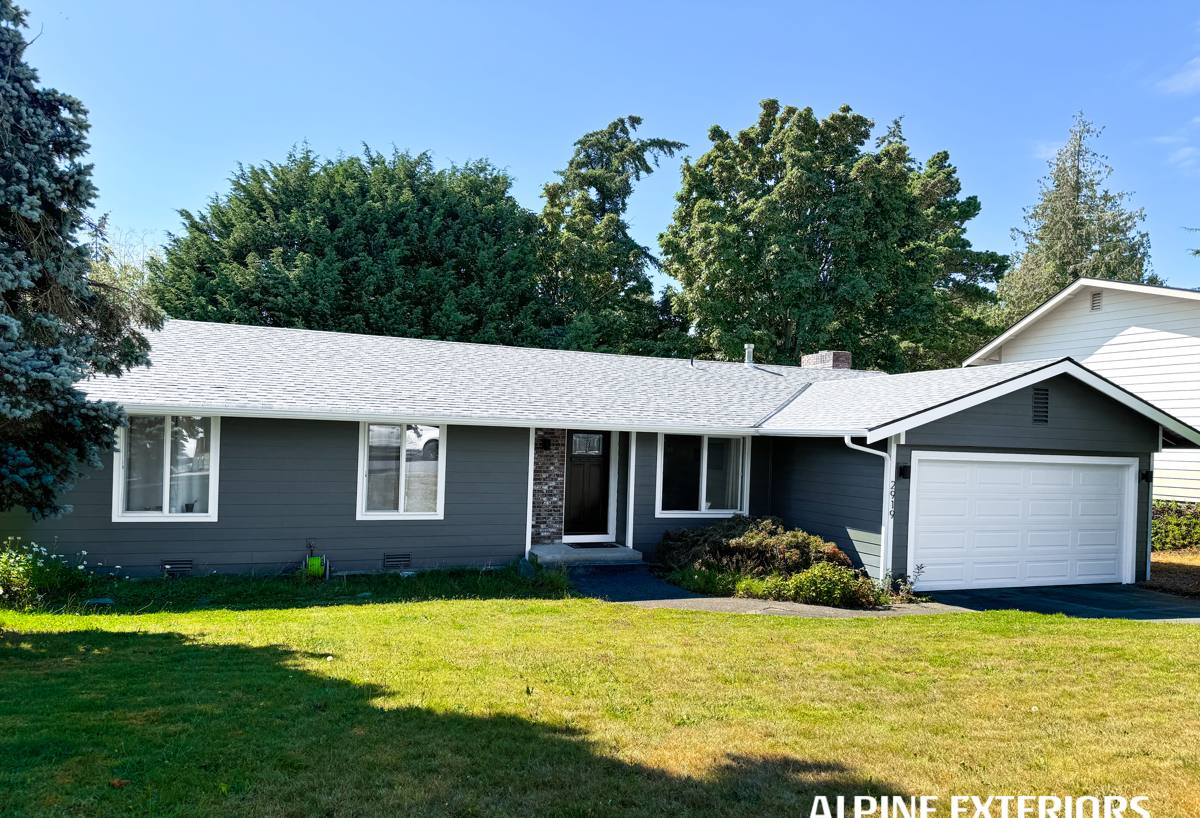
Why Acme's Climate Is Hard on Siding
Moisture That Doesn't Leave
Shaded lots and tree canopy are common around Acme, and while that's part of what makes the area appealing, it also means siding stays wet longer after every rain. Wood-based products — cedar, primed spruce trim, engineered wood siding — depend on drying out between rain events. When that drying window shrinks, moisture works its way into seams, fastener holes, and butt joints, and the damage compounds season after season.
Moss, Algae, and Organic Growth
A long, wet moss season means siding, trim, and the bottom courses near grade or landscaping stay damp and shaded for extended stretches. Moss and algae hold moisture directly against the siding surface, which accelerates rot in wood-based products and can stain even the most durable materials if it's never cleaned off.
Driving Rain and Wind-Driven Water
Storms moving through Whatcom County don't always fall straight down. Wind-driven rain gets pushed sideways into laps, corners, and penetrations — around window and door trim, hose bibs, light fixtures, and anywhere siding meets a different material. Those transition points are where the majority of the repair calls we see actually originate.
Signs an Acme Home Needs Siding Repair
Most siding problems give warning signs well before they turn into a bigger repair. Here's what we tell Acme homeowners to watch for:
- Soft, spongy, or bubbling spots when you press on the siding, especially near the bottom courses
- Visible cracks, splits, or gaps at panel seams, corners, or butt joints
- Peeling or bubbling paint that keeps coming back in the same spot year after year
- Dark streaking, persistent moss, or algae growth that doesn't go away after cleaning
- Warping, cupping, or boards that no longer sit flat against the wall
- Stains or discoloration on interior walls near exterior corners — a sign water has already gotten past the siding
- Gaps or separation around window and door trim
- Increased pest activity — carpenter ants and similar pests are often drawn to siding that's already holding moisture
Any one of these on its own might be minor. Several of them clustered in one area, or repeat problems in the same spot every year, usually mean there's a water intrusion path that hasn't been found yet.
What a Correct Siding Repair Actually Involves
A lot of siding "repairs" are really just a new piece of siding nailed over the same unresolved problem. That gets you a house that looks fine for a season or two and then fails again in the same place. We do it differently.
1. Find the Actual Cause
Before we touch a single board, we're looking for why that section failed — a flashing gap, a caulk joint that dried out and cracked, a missing kick-out flashing, siding installed too close to grade or a roofline, or a fastener pattern that let water track behind the panel.
2. Check What's Behind the Siding
Siding is the visible layer, but the water-resistive barrier and flashing details underneath are what actually keep a house dry. If those are compromised, replacing the surface material without addressing what's underneath just resets the clock on the same failure.
3. Repair to Match, Not Just to Cover
Whenever possible, we match existing siding profile, reveal, and finish so a repair doesn't stand out as an obvious patch. Where the existing material is beyond a clean match — or beyond what we're willing to put our name on — we'll tell you honestly, rather than force a bad match to save a trip.
4. Correct the Flashing and Water Management
This is the step that actually prevents the next repair call. Proper flashing at windows, doors, roof-to-wall intersections, and penetrations, along with correct fastening and gapping per manufacturer spec, is what keeps water moving away from the wall instead of into it.
How Different Siding Materials Hold Up to Repair in This Climate
What material is on the house changes what a repair looks like — and how often you'll need one. Here's how the materials we commonly see on Whatcom County homes compare under repair conditions.
| Material | How It Handles Moisture | Repair Difficulty | Typical Long-Term Outlook |
|---|---|---|---|
| Vinyl | Doesn't rot, but seams and J-channels let water track behind the panel | Individual panels replace easily; matching older, faded panels is often impossible | Cracks in cold weather, warps near heat sources, fades unevenly over time |
| Cedar / primed spruce | Absorbs moisture readily; shaded, damp areas accelerate rot | Labor-intensive — often requires cutting back to sound wood and refinishing | Needs ongoing paint/stain maintenance; highest risk of recurring repairs in shaded lots |
| Engineered wood (e.g. LP SmartSide) | Resin-treated but still wood-based; edge and cut-end swelling is the common failure point | Moderate; edge damage often means full board replacement | Performs well when sealed and maintained correctly; vulnerable if edges go unsealed |
| James Hardie fiber cement | Doesn't absorb moisture the way wood-based products do; resists swelling and rot | Sections repair cleanly when installed to spec; factory finish limits touch-up mismatch | Built for this climate specifically, with strong long-term performance when installed correctly |
We repair whatever material is already on your home — you don't have to be a Hardie customer for us to fix your siding. But when the conversation turns to "is it worth repairing again, or time to replace," this is the material we recommend, and it's the only one we install on full siding jobs.
Why We Only Install James Hardie
When a repair reveals more damage than a patch can reasonably fix — or when a homeowner is ready to stop repairing a material that keeps failing in the same spots — we recommend James Hardie fiber cement, and we don't install anything else. That's a deliberate standard, not a sales default.
Fiber cement doesn't feed moss and algae the way wood-based products can, it doesn't absorb water and swell at cut edges the way engineered wood can if left unsealed, and it's non-combustible, which matters given how many Whatcom County properties border trees and brush. Hardie's ColorPlus factory finish is baked on rather than field-applied, which means better UV and fade resistance than a job-site paint job, and their HZ5 product line is engineered specifically for climates with heavy moisture exposure — exactly what Acme deals with for a large part of the year. It also carries a strong transferable warranty, which matters if you ever sell the house.
We're not going to tell you every other product on the market is junk — vinyl, engineered wood, and cedar all have legitimate uses and long track records. But we've made a professional call that Hardie is what holds up best to this specific climate with the least amount of callback repair work, and it's the only material we're willing to put our name behind for a full install.
Our Siding Repair Process
- On-site inspection. We look at the damaged area and the surrounding siding, flashing, and trim — not just the spot you called about.
- Honest diagnosis. We tell you what's actually causing the problem, what it will take to fix it correctly, and whether a repair or a broader replacement makes more sense.
- Clear scope and estimate. No pressure, no inflated scope — just what the repair actually requires.
- Correct execution. We fix the water management issue first, then match or replace the siding, with proper fastening and sealing to spec.
- Final walkthrough. We show you what was done and why, so you understand your home's exterior better than you did before we showed up.
Repair or Replace? How We Help You Decide
Not every siding problem needs a full re-side, and not every repair is worth doing if the underlying material is on its way out. These are the factors we weigh with homeowners:
| Factor | Favors Repair | Favors Replacement |
|---|---|---|
| Extent of damage | Isolated to one or two areas | Recurring problems in multiple locations |
| Age of existing siding | Relatively new, otherwise sound | Nearing or past expected service life |
| Cause of failure | A single fixable flashing or sealant issue | Systemic moisture intrusion behind the wall |
| Material match | Discontinued profile/color still reasonably matchable | No longer manufactured, or fading makes a seamless match impossible |
| Long-term goals | Planning to sell or hold short-term | Planning to stay long-term and want to stop recurring repair costs |
We'll always give you our honest read on where your home falls on that spectrum. Plenty of repair calls end with us fixing exactly what you called about and nothing more.
Why It Matters to Hire a Crew That Already Works Acme and the Surrounding Area
A contractor who regularly works homes in Acme and greater Whatcom County has already seen how the moss, moisture, and driving rain here actually behave against different siding materials — not just what a manufacturer's spec sheet says should happen. That local pattern recognition is often the difference between a repair that lasts and one that's back on the schedule next winter. We also know what correct flashing and water management look like for this specific weather, not a generic install method borrowed from a drier climate.
If your siding is showing signs of trouble — soft spots, recurring stains, cracked seams, or persistent moss — we're happy to take a look and give you a straight answer about what it needs. Reach out for a free, no-pressure estimate, and we'll walk your home's exterior with you and explain exactly what we find.