 Lynden Window
 Why Birch Bay Roofs Wear Differently Than Roofs Inland
Birch Bay sits right on the water, and that changes what a roof has to deal with every single day. A shingle roof a few miles inland in Lynden faces wind, rain, and the usual Whatcom County moss pressure. A roof in Birch Bay faces all of that plus salt-laden air coming off the water, more direct wind exposure with fewer trees to break it up in some spots, and long stretches of damp shade in others where moisture just sits. None of this means asphalt shingles are the wrong choice for a waterfront-adjacent home — they're not. It means the roof has to be specified and installed with that exposure in mind, not treated like a standard inland job.
Three things drive most of the early roof failures we see on Birch Bay homes: corrosion of exposed metal components from salt air, water intrusion at edges and valleys from wind-driven rain, and moss or algae growth from the long wet, shaded season that's typical of this part of Washington. Each of these is preventable with the right materials and detailing — but only if the crew doing the work is actually accounting for them.
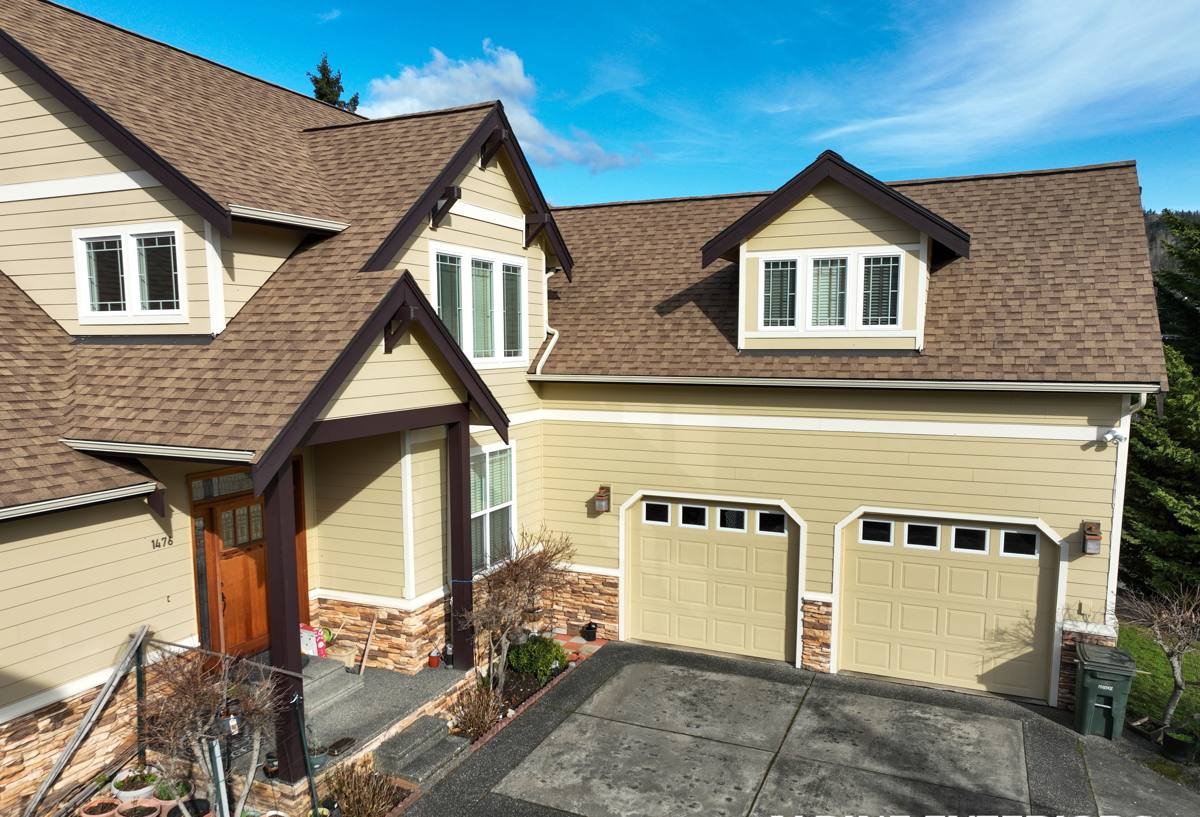
Salt Air and Driving Rain: What They Actually Do to a Roof
Corrosion of Fasteners and Flashing
Salt air is hard on anything metal. Nails, staples, drip edge, step flashing, and vent flashing that aren't rated for coastal exposure can start to corrode years before they would inland. Once a fastener or a piece of flashing starts to fail, it stops doing its job quietly — you usually don't see it until there's a stain on the ceiling or rot in the decking underneath. This is why fastener and flashing selection matters more here than it does on a typical inland reroof.
Wind-Driven Rain
Rain that comes in sideways off the water behaves differently than rain falling straight down. It can work its way up under shingle tabs, push past standard nailing patterns, and find gaps at valleys, chimneys, and roof-to-wall transitions that would never leak in calmer conditions. A roof built for Birch Bay needs sealed, high-wind-rated shingles, proper nailing (not stapling, and not high-nailing to save time), and extra attention to every penetration and transition point.
Moss, Algae, and the Long Wet Season
Whatcom County's moss season is long, and Birch Bay's mix of shade, humidity, and salt moisture makes it worse in spots that don't get much direct sun or wind to dry out. Moss holds water against the shingle surface, works into the granule layer, and over time lifts shingle edges — which is exactly where wind-driven rain wants to get in. Black or greenish streaking on a north-facing slope isn't just cosmetic; it's a sign that organic growth has a foothold and moisture is being held on the roof longer than it should be.
The fix isn't just periodic cleaning. It starts with shingle selection, roof ventilation, and keeping overhanging branches back so sun and airflow can actually reach the roof surface. We'll cover each of those below.
What a Correctly Installed Shingle Roof Needs in This Area
Underlayment and Ice-and-Water Barrier
A synthetic underlayment across the whole roof is the baseline here, not an upgrade. In addition, we run self-adhering ice-and-water barrier at eaves, valleys, and around all penetrations — the spots where wind-driven rain and ponding meltwater are most likely to find a way in. On homes with more direct water exposure, extending that barrier further up the eave than a standard inland job is a reasonable, low-cost step that pays for itself the first time a storm pushes rain uphill under the shingle tabs.
Flashing and Fasteners Rated for Coastal Exposure
We use corrosion-resistant flashing and fasteners on homes with direct or near-direct water exposure — this typically means stainless steel or heavy hot-dip galvanized instead of standard electro-galvanized. It costs a little more up front. It also means the flashing is still doing its job in fifteen years instead of quietly failing in five.
Nailing Pattern and Wind Rating
Every shingle has a rated nailing pattern, and it's the single most skipped detail on cheap reroofs. Six-nail patterns instead of four, nails placed in the manufacturer's nailing zone (not high or low), and shingles rated for higher wind speeds all matter more on an exposed lot near the water than they do tucked into a sheltered inland yard.
Choosing the Right Shingle: Algae Resistance and Wind Rating
Not every asphalt shingle is built the same, and for Birch Bay the two specs that matter most are algae resistance and wind rating.
- Algae-resistant (AR) shingles have copper or zinc granules blended into the surface that inhibit the growth of blue-green algae, which is what causes the dark streaking common on shaded, moisture-prone roofs in this region.
- Higher wind-rated shingles use a stronger adhesive sealant strip and are tested to stay locked down in higher sustained winds — worth the upgrade on lots with open water exposure.
- Architectural (dimensional) shingles are thicker and heavier than basic three-tab shingles, which generally helps them perform better against both wind uplift and moss encroachment over time.
We install shingles from established manufacturers that offer AR granule technology and wind ratings suited to coastal exposure. We're glad to walk through the specific product lines and warranty terms available at the time of your estimate rather than quote details here that can change by manufacturer and season.
Shingle Options and Cost Factors
The table below is a general guide to help frame the conversation — actual pricing depends on roof size, pitch, tear-off condition, and current material costs, which we'll cover in a written estimate.
| Shingle Type | Typical Lifespan | Wind Rating | Best Fit |
|---|---|---|---|
| 3-Tab (standard) | 15–20 years | Standard | Budget reroofs on sheltered, low-exposure lots |
| Architectural (standard AR) | 25–30 years | Higher | Most Birch Bay homes — the practical baseline for coastal exposure |
| Premium/Designer Architectural | 30+ years | Highest | Waterfront or highly exposed lots, or homeowners prioritizing longevity and appearance |
As a general rule, we steer most Birch Bay homeowners toward at least a standard architectural AR shingle. The jump in material cost from three-tab is modest compared to the added years of service and the reduced moss and wind-related maintenance you'll deal with afterward.
Roof Deck and Ventilation Matter Just as Much as the Shingles
A new roof is only as good as what's underneath it. Before any shingles go down, we check the decking for soft spots, delamination, or rot — common where a prior roof let moisture sit for years, especially on shaded slopes. Damaged sheathing gets replaced, not shingled over.
Ventilation is the other half of this. A roof that can't breathe traps heat and moisture in the attic, which contributes to premature shingle aging from underneath and can worsen moss growth by keeping the roof deck damp longer after a rain. Balanced intake and exhaust ventilation — soffit vents paired with ridge or roof vents — helps the roof dry out between storms instead of staying saturated through the wet season.
Our Process for a Birch Bay Reroof
- Inspection and estimate. We look at the existing roof, deck condition, ventilation, and exposure to wind and salt air, and put together a written scope.
- Tear-off. Full removal of old roofing so the deck can be properly inspected — we don't recommend layering over an existing roof on a home facing this kind of weather exposure.
- Deck repair. Any rotted or delaminated sheathing is replaced before anything else goes down.
- Ice-and-water barrier and underlayment. Installed at eaves, valleys, and penetrations, then across the full deck.
- Flashing. New flashing at all valleys, walls, chimneys, and penetrations, using fasteners suited to the home's exposure.
- Shingle installation. Installed to the manufacturer's specified nailing pattern for the shingle's rated wind speed.
- Ventilation check. Intake and exhaust ventilation confirmed or upgraded as part of the job, not as an afterthought.
- Cleanup and final walkthrough. Site cleaned, magnetic sweep for stray fasteners, and a walkthrough of the finished roof and warranty paperwork.
Keeping a Birch Bay Roof Healthy After Installation
A well-installed roof still needs some basic upkeep in this climate. A short annual routine goes a long way toward getting the full lifespan out of your shingles.
- Clear gutters and downspouts each fall so water isn't backing up under the eaves during winter storms.
- Have moss or algae growth addressed early — light growth is easy to manage; established moss that's lifted shingle edges is a bigger job.
- Keep overhanging branches trimmed back to let sun and air reach shaded slopes.
- After major windstorms, do a visual check (from the ground, or have us take a look) for lifted or missing shingles.
- Schedule a roof inspection every couple of years, or sooner if you notice staining on interior ceilings or exterior fascia.
Why Hiring a Crew That Already Works Birch Bay Matters
Roofing crews who mostly work more sheltered, inland jobs don't always adjust their approach for a lot that sits close to the water. That shows up later — in fasteners that corrode ahead of schedule, flashing that wasn't upgraded for the exposure, or a nailing pattern that was fine for a calmer site but not for one that takes wind straight off the bay.
We work across Whatcom County, including Lynden and the Birch Bay area, and we treat waterfront and near-waterfront exposure as a normal part of the job, not a special case. That means the estimate you get already accounts for the conditions specific to your lot, and the materials and details we recommend are chosen with that exposure in mind from the start — not added on after something fails.
If you're dealing with moss buildup, a roof that's due for replacement, or you just want an honest read on how much life is left in your current shingles, we're happy to take a look. Reach out for a free, no-pressure estimate using the form below.