 Lynden Window
 Deck Replacement Built for Sumas Conditions
Sumas sits at the far edge of Whatcom County, tucked against the Canadian border with the Nooksack floodplain and foothill weather patterns close by. It isn't a coastal town the way some Puget Sound communities are, so decks here see less direct salt exposure than homes right on the water. What they do get, consistently, is a long wet season, heavy fall and winter rain moving in off the foothills, and enough shade and moisture lingering into spring to grow a serious moss problem on any horizontal surface that doesn't shed water well. A deck built or maintained without that in mind starts showing problems years before it should.
We work on decks throughout Lynden and the surrounding Whatcom County communities, including Sumas, and the deck failures we get called out for follow a pattern. It's rarely one dramatic event. It's slow moisture intrusion at ledger boards and post bases, fastener corrosion nobody checks until a board is loose, and moss and algae holding water against wood or composite decking long after a dry afternoon would otherwise have let it evaporate. Replacement done right addresses all of that, not just the boards you can see.
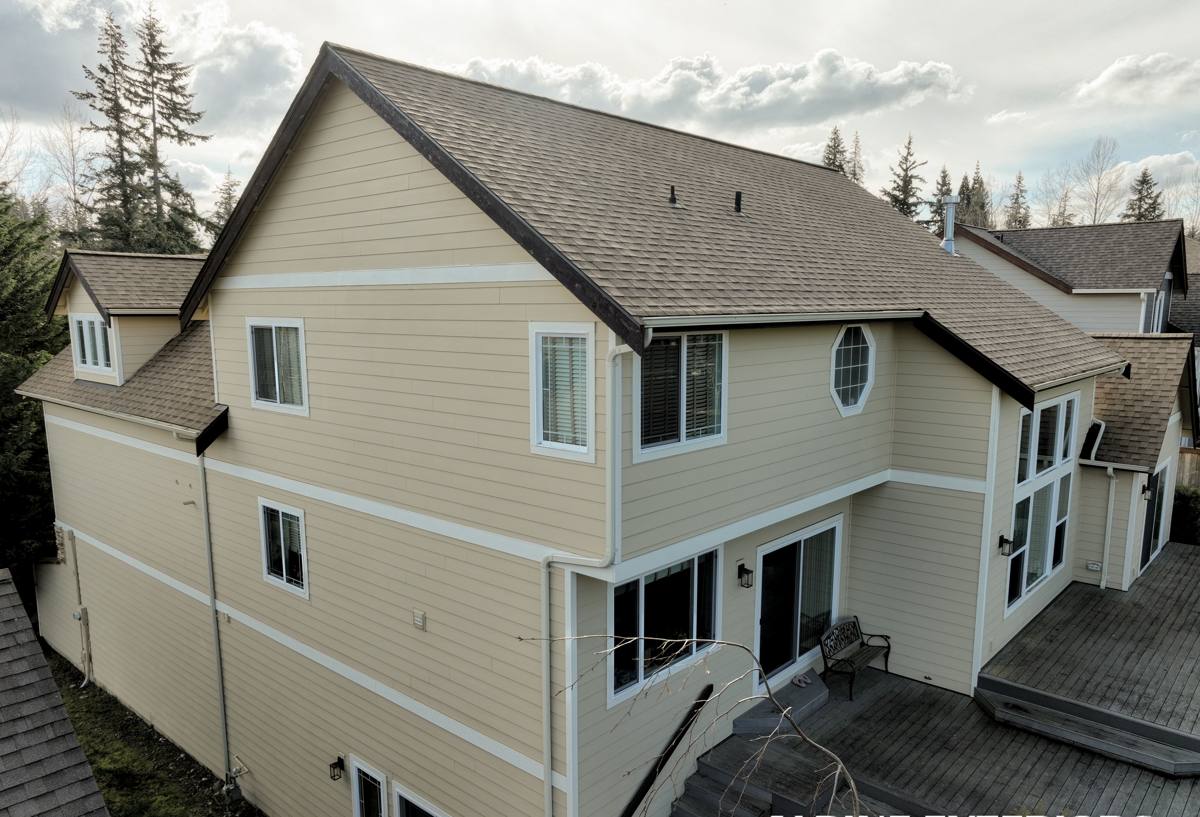
How Sumas Weather Wears Down a Deck
Rain and Moisture Cycling
Whatcom County gets a long stretch of overcast, rainy months, and decks near Sumas go through repeated wet-dry cycles for much of the year. Wood swells when it absorbs moisture and shrinks as it dries, and that constant movement is what loosens fasteners, opens up joints, and eventually cracks boards at their weakest points. Composite decking doesn't swell and shrink the same way, but water sitting on its surface or trapped underneath it still creates conditions for mold, mildew, and a slick walking surface.
Moss, Algae, and Shade
Any deck with tree cover, a north-facing exposure, or limited afternoon sun is going to grow moss faster than a full-sun deck. Once moss takes hold, it holds moisture against the decking surface around the clock, not just during rain. On wood decking that accelerates rot at the board surface. On composite decking it stains the surface and creates a slip hazard that pressure washing alone won't permanently solve. A deck built with the right slope, spacing, and drainage detail resists moss far longer than one that was simply nailed down flat.
Ground Contact and Substructure Moisture
The part of a deck most homeowners never see is usually the part failing first. Posts, beams, and joists close to grade or under a deck with poor airflow stay damp longer after every rain. That's where we find the rot that actually determines whether a deck gets replaced or just re-decked. Any honest deck replacement quote should include an inspection of this structure, not just a plan to swap out the visible boards.
Signs a Sumas Deck Needs Replacing, Not Just Repair
- Boards that feel spongy, springy, or soft underfoot, especially near the house or in shaded corners
- Persistent moss or algae staining that returns within weeks of cleaning
- Visible gaps, cupping, or splitting concentrated on one side of the deck (usually the shadier or less-drained side)
- Rust streaks around fasteners or visibly corroded screws and joist hangers
- A ledger board area that looks darker, swollen, or separated from the house siding
- Railings or stairs that have developed noticeable wobble
- A structure more than 15-20 years old that has never had the substructure inspected
If it's mostly surface wear on a deck with a sound frame, repair or re-decking can make sense. If the substructure is compromised, patching the visible boards just hides the problem for another season or two.
What a Correct Deck Replacement Involves
Full Removal and Structural Inspection
We remove the old decking, railings, and any compromised framing down to a point where we can actually see and test the condition of posts, beams, joists, and the ledger connection to the house. This is the step that gets skipped when a job is priced too low, and it's the step that determines whether the new deck will actually outlast the old one.
Ledger Board and Flashing Detail
Where a deck attaches to the house, proper flashing keeps water from working its way behind the siding and into the wall structure over time. This is one of the most common trouble spots we find on older decks, and it's not something that shows up until you pull the decking back and look. Getting this detail right matters more in a climate with as much sustained rain as Whatcom County sees than almost any other part of the build.
Drainage and Slope
A deck surface should have a slight slope away from the house so water doesn't pool or sit against the siding. This is a small detail during framing that has an outsized effect on how fast moss and algae take hold later, and how long the decking itself lasts.
Fasteners and Hardware
Corrosion-resistant, code-rated fasteners and structural hardware matter more in a wet climate than in a dry one. Mismatched or undersized hardware is a common shortcut on lower-bid jobs, and it's usually invisible until it fails.
Decking Material Installation
Whether we're installing wood or composite decking, proper board spacing for expansion and drainage, correct fastening patterns, and attention to end-grain sealing on wood all affect how the deck handles Whatcom County's wet season for years to come, not just its first summer.
Choosing Materials for a Sumas Deck
There isn't one right decking material for every home. The right choice depends on budget, how much upkeep you want to do, sun exposure, and how long you plan to stay in the home. We'll give you a straight answer on trade-offs rather than steering you toward whatever is easiest for us to install.
| Material | Upfront Cost | Maintenance | Moss/Moisture Behavior |
|---|---|---|---|
| Pressure-treated wood | Lowest | Annual cleaning and periodic sealing recommended | Prone to moss in shaded areas if not sealed and cleaned regularly |
| Cedar | Moderate | Regular sealing to maintain color and resist moisture | Naturally more rot-resistant but still needs upkeep in constant shade/damp |
| Composite decking | Higher | Low — occasional washing | Doesn't rot, but surface staining from moss/algae still needs cleaning |
| PVC decking | Highest | Lowest | Most moisture-resistant option; least prone to organic staining over time |
We install a range of quality wood and composite products. When we recommend against a particular product line for a given deck, it's usually about how it handles long-term moisture exposure or installation sensitivity in our climate, not a knock on the brand generally — we'll explain the specific reasoning for your situation.
Cost Factors for a Sumas Deck Replacement
- Deck size and shape — square footage plus complexity (multiple levels, angles, built-in features) drives labor time
- Substructure condition — how much of the framing, posts, and footings need replacing versus reusing
- Decking material — pressure-treated wood, cedar, composite, and PVC span a wide price range
- Railing system — wood, metal, cable, or composite railing all price differently
- Height and access — a deck built up off a sloped yard costs more to frame and safely access than one near grade
- Permit requirements — structural work often requires permitting through the county or city, which we handle as part of the process
We won't quote a number without seeing the deck. Any estimate given sight-unseen is a guess, and guesses are how homeowners end up with change orders mid-project.
Our Process for Sumas Deck Replacement Projects
- On-site assessment — we inspect the existing deck, including probing for soft spots and checking the ledger and post bases, and talk through what you actually want from the new space
- Written estimate — a clear scope of work and price, with material options laid out honestly
- Permitting — we handle the paperwork for structural deck work where required
- Demolition and disposal — full removal of the old structure, hauled off, not left in your yard
- Framing and structural work — new or reinforced posts, beams, joists, and proper flashing at the house connection
- Decking, railing, and stairs installation — built to spacing and fastening standards suited to our climate
- Final walkthrough — we go over the finished deck with you and flag any maintenance steps specific to your material choice
Why It Matters to Hire a Crew That Already Works in Sumas
Deck work in Whatcom County isn't the same job as deck work in a drier climate, and it isn't identical from one town to the next inside the county either. A crew that regularly works Lynden and Sumas already knows how local permitting works, what soil and drainage conditions look like on this side of the county, and how a given deck's orientation and shade pattern will affect it over the following winters. That's not something you can fully substitute with a generic national checklist. It's the difference between a deck that gets re-inspected every few years for the same recurring moss and moisture issues, and one that's built once to actually handle the conditions it's sitting in.
We also stand behind our own work locally, which matters when a warranty claim means a phone call and a truck showing up, not a call center in another state.
Maintaining a New Deck Through Whatcom County's Wet Season
Even a well-built deck needs some seasonal attention here. A few habits go a long way toward protecting the investment:
- Sweep leaves and debris off the deck surface regularly in fall, especially in shaded corners where moisture collects
- Clean moss and algae buildup at the first sign of it rather than waiting for a heavy layer to form
- Check that gutters and downspouts near the deck are directing water away, not onto or under it
- Reseal wood decking on the manufacturer's recommended schedule, typically every one to two years depending on sun exposure
- Walk the deck once a year and check for loose boards, soft spots, or fastener corrosion before they become bigger problems
If your deck in Sumas is showing its age, or you just want an honest opinion on whether it needs replacing or can be repaired, we're happy to come take a look. Reach out for a free, no-pressure estimate using the form below.