 Lynden Window
 Why Siding in Custer Wears Differently Than Siding Inland
Custer sits close enough to the water that homes here deal with a mix most inland Whatcom County properties don't: salt-laden air off the Strait of Georgia and Birch Bay, driving wind-rain that hits siding sideways instead of just running down it, and a long wet season that keeps north and west walls damp for weeks at a stretch. Add in the tree cover common on rural Custer lots, and you get a moss and algae season that can run eight or nine months a year in shaded spots. None of this is exotic — it's just a heavier version of what every Whatcom County exterior deals with. But it means siding repair here has to account for causes that a drier climate wouldn't force you to think about.
When we get a call for siding repair in Custer, the first question isn't "what does it look like" — it's "what's been happening to that wall for the last ten or twenty years." A cracked panel on a south-facing gable and the same crack on a shaded north wall next to mature trees are two different repair jobs, even if the damage looks identical from the driveway.
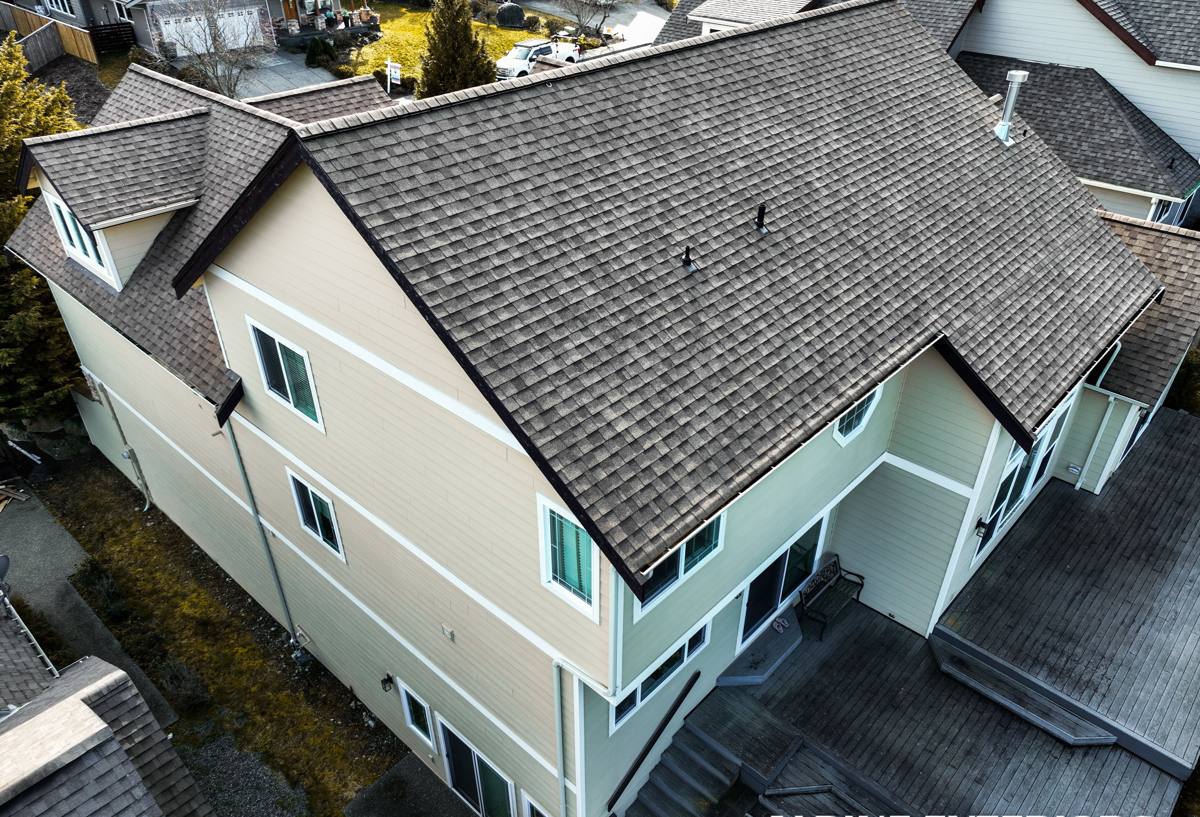
Signs Custer Homeowners Should Not Wait On
Some siding problems are cosmetic. Others are early warnings that moisture has already gotten behind the surface layer. Knowing which is which saves you from either overpaying for an unnecessary full re-side or underpaying for a patch that fails again in a year.
- Soft or spongy spots when you press on the siding, especially near the bottom courses or under windows
- Persistent black or green streaking that comes back within weeks of cleaning
- Visible cracking, cupping, or splitting along panel edges or at butt joints
- Paint that's bubbling, peeling, or failing faster than the rest of the house
- Gaps opening up around trim, corner boards, or window and door casings
- A musty smell in an interior room that backs onto an exterior wall
- Visible daylight or drafts at siding seams from inside an attic or crawlspace
Any one of these can be minor. Two or three together, especially on a wall that gets driving rain or stays shaded most of the day, usually means water has been getting past the surface for a while.
What's Actually Causing the Damage
In our experience working Custer properties, three causes account for most of the repair calls we get:
- Wind-driven rain intrusion at panel laps, trim joints, and penetrations that were caulked instead of properly flashed
- Moss and organic growth holding moisture against the siding face long after a storm has passed, which is what really breaks down paint and substrate over time — the moss itself is more of a symptom than the root cause
- Material fatigue — siding products that simply weren't built to take this many wet-dry cycles over the years, which shows up as warping, swelling, or fastener pull-through
What a Correct Siding Repair Actually Involves
A repair that only replaces the damaged board and stops there is a repair that's likely to fail again. Here's what we check before we touch a single panel:
1. Diagnose Before You Patch
We pull back the affected siding, not just around it, to see what the water-resistive barrier and sheathing look like underneath. If the barrier is torn, improperly lapped, or the sheathing has soft spots, replacing the visible siding without addressing that is a cosmetic fix on top of an active problem.
2. Match or Upgrade, Don't Guess
If the existing siding is still a product we'd stand behind, we match it as closely as materials allow. If it's a product with known long-term weaknesses in this climate — more on that below — we talk through whether a section repair or a phased transition to a better product makes more sense for the budget.
3. Flash It Properly
Every seam, joint, and penetration gets proper flashing and correct lap sequencing, not just sealant. Sealant fails; flashing sheds water by design and keeps working long after caulk has cracked.
4. Address the Moisture Source, Not Just the Symptom
If moss growth or standing moisture caused the failure, we look at what's feeding it — poor airflow, overhanging branches, grading, gutter overflow — and flag it, even if it's outside the siding scope. A perfect repair next to an untreated moisture source just buys you a few extra years.
Repair Outcomes Vary a Lot by Siding Material
Not all siding repairs are equal, and this is where a lot of homeowners get surprised. The material already on your house determines how well a repair will hold, how well it'll match, and how long before you're back to square one.
| Siding Material | Repair Difficulty in This Climate | Common Long-Term Issue |
|---|---|---|
| Vinyl | Easy to patch, hard to color-match aged panels | Warping and fading; brittle in cold snaps |
| Cedar | Moderate — sound wood is repairable, rot isn't | Ongoing rot cycle without diligent recoating |
| LP SmartSide (engineered wood) | Repairable if caught early | Edge swelling and delamination once moisture gets into a cut edge |
| Primed spruce / OSB-based panels | Difficult once moisture intrudes | Rapid substrate failure behind the panel |
| James Hardie fiber cement | Straightforward — panel swap-outs blend cleanly | Minimal; failures are almost always installation-related, not material-related |
This is not a knock on any homeowner's existing siding choice — most of these products were installed by a previous owner or builder, and plenty of them look fine for years. It's simply what we see when we open walls up for repair across Custer and greater Lynden.
Why We Repair Toward James Hardie, Not Away From It
We install James Hardie fiber cement siding exclusively. We don't install vinyl, LP SmartSide, Cemplank, Allura, primed spruce, or cedar. That's a standard we hold for new installs, and it shapes how we approach repairs too.
When a repair is small and the existing material is sound, we'll match it — we're not going to talk a homeowner into ripping off a healthy wall of siding to make a point. But when a wall has repeated failures, or the damaged section is large enough that a full re-side is already on the table, we recommend Hardie for a specific set of reasons that matter more here than in a drier climate:
- Non-combustible fiber cement that doesn't feed a wildfire the way wood-based products can
- Engineered for wet climates — Hardie's HZ5 product line is specifically formulated for regions with prolonged moisture exposure, which describes most of Whatcom County
- ColorPlus factory finish that resists the fade and chalk that repeated rain and UV cycles cause on field-painted siding, so patch sections keep matching longer
- Dimensionally stable — it doesn't swell, cup, or delaminate the way wood-based and engineered-wood products can once moisture gets past a cut edge
- Strong transferable warranty backing the material, which matters if you sell the home before the siding's service life is up
Fiber cement isn't magic — it still needs correct flashing, correct fastening, and paint-grade caulking only where the product calls for it. But it removes the material-level weaknesses that account for most of the repeat repair calls we see on other products.
Our Repair Process
- On-site inspection of the damaged area and a check of adjacent walls for related issues
- Removal of affected panels to inspect the water-resistive barrier and sheathing underneath
- Honest recommendation: spot repair, section replacement, or phased re-side, based on what we find — not a default up-sell
- Proper flashing and lap sequencing at every seam and penetration we touch
- Material match where the existing siding is sound; James Hardie fiber cement where we're replacing a failed section
- Final walk-through so you can see exactly what was found and what was done about it
What Affects the Cost of a Siding Repair
| Factor | Why It Matters |
|---|---|
| Extent of hidden moisture damage | Sheathing or framing repair adds cost beyond the siding itself |
| Material being matched | Discontinued vinyl colors or aged cedar can be harder to match than a straightforward Hardie panel swap |
| Wall exposure | North-facing and shaded walls with heavier moss growth often need more prep work |
| Access | Second-story or tight-clearance sections take longer to stage and work safely |
| Scope | A single-panel patch and a full-wall section replacement are priced very differently |
We won't quote a number without seeing the wall — anyone who does is guessing. What we can tell you is that a proper diagnosis up front is what keeps a repair from turning into a repeat visit.
Why Hiring a Crew That Already Works Custer Matters
Custer isn't a big town, and its exterior challenges aren't generic. A crew that mostly works drier, more sheltered neighborhoods can still do competent work, but they're not necessarily thinking about wind-driven rain angles off the Strait, the moss cycle on shaded rural lots, or how Whatcom County's building code treats water-resistive barrier requirements in high-exposure zones. A crew that regularly works Custer and the surrounding Lynden area brings that pattern recognition to your specific wall, not a generalized approach borrowed from a different climate.
That local familiarity also means we're not learning on your house. We've seen how each of the common siding materials in this area actually ages here — not in a brochure, but on real walls a few miles from yours.
If you're noticing damage, discoloration, or drafts on your Custer home's siding, we're glad to take a look. We offer free, no-pressure estimates — we'll tell you honestly whether you need a repair, a section replacement, or nothing urgent at all. Use the form below to get started.