 Lynden Window
 Building Decks That Actually Hold Up in Maple Falls
A deck in Maple Falls lives a harder life than the sales brochure for the decking material usually admits. This is a wooded, moisture-heavy corner of Whatcom County, tucked up near the foothills outside Lynden, and the weather here doesn't do a deck any favors. Long wet stretches, heavy tree cover on a lot of properties, and short winter days that never quite dry things out mean a deck built the way it might be built in a drier climate will start showing problems years before it should. We build decks specifically with this environment in mind, not a generic set of blueprints pulled off the shelf.
The marine-influenced air that moves through Whatcom County carries more moisture than most homeowners expect, even well inland from the water. Combined with driving rain that comes in sideways during winter storms and a moss season that can stretch from fall through spring, a deck here needs to be built to shed water, dry out between storms, and resist the kind of slow rot that starts underneath where nobody's looking.
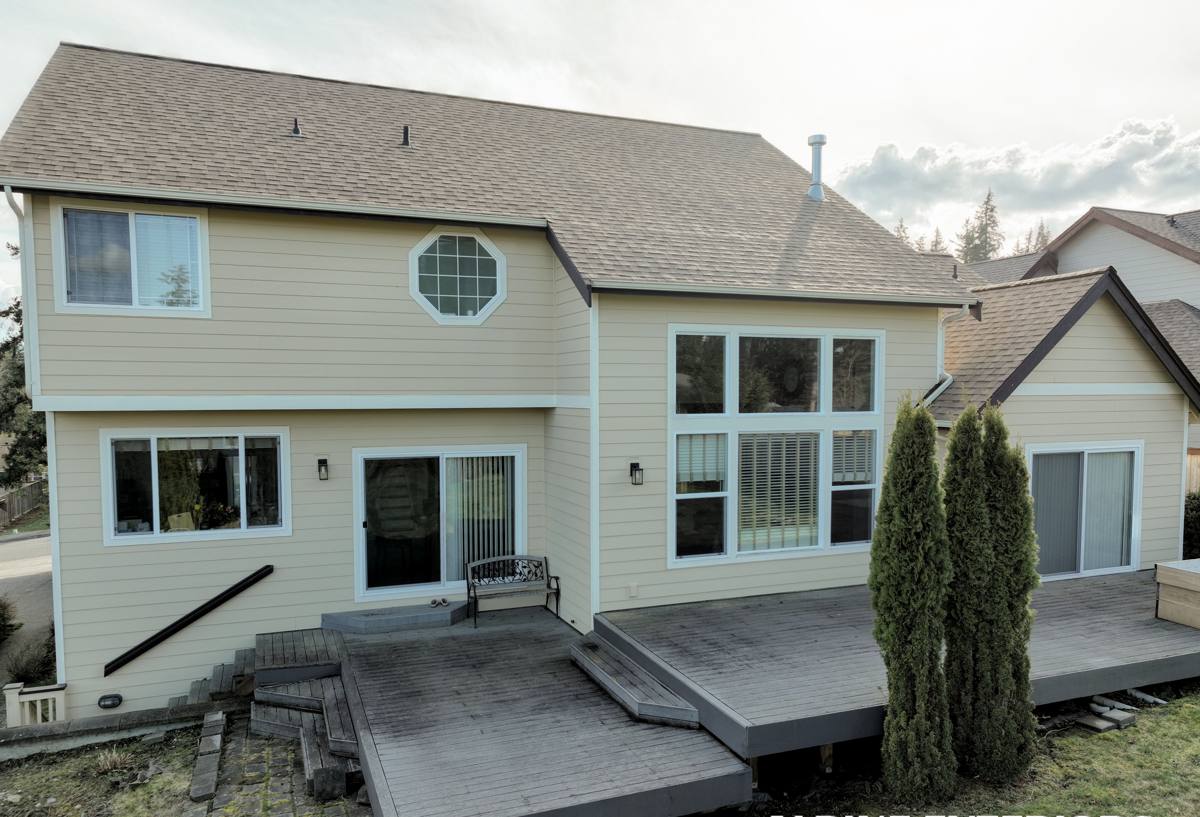
What Whatcom County Weather Does to an Outdoor Deck
Moss and Standing Moisture
Moss doesn't just grow on roofs. Given a shaded deck surface that stays damp for days at a time, moss and algae will colonize deck boards, railings, and especially the north-facing side of any structure that doesn't get much direct sun. Beyond looking bad, moss holds moisture against the wood or composite surface, which accelerates surface degradation and turns boards slick and dangerous underfoot.
Freeze-Thaw Cycles
Maple Falls sits at a higher elevation than Lynden proper, so it sees more frequent freezing temperatures in winter. Water that's soaked into a crack in a deck board or worked its way into a fastener hole expands when it freezes, widening the damage a little more each cycle. Over several winters, that's how a small crack becomes a split board.
Sun Exposure on the Few Clear Days
It's easy to forget that UV damage matters here too. On the sunny stretches, especially in summer, unprotected wood grays and checks quickly because it's already been softened by months of moisture. The combination of wet-then-dry cycling is harder on a deck than either condition alone.
Choosing the Right Decking Material for This Climate
There's no single "best" decking material — there's the right material for how a homeowner wants to use the deck, how much upkeep they're willing to do, and what budget they're working with. Here's how the common options actually perform in a climate like ours.
| Material | Moisture Behavior | Maintenance | Typical Lifespan |
|---|---|---|---|
| Pressure-treated wood | Absorbs and releases moisture readily; needs a sealed surface to slow it down | Annual cleaning and re-sealing recommended | 15-25 years with upkeep |
| Cedar | Naturally rot-resistant but still moves with moisture; grays without treatment | Periodic cleaning and oil/stain if color is wanted | 15-20 years |
| Composite decking | Doesn't absorb water into the board itself, but moisture can still collect on the surface and in gaps | Occasional washing to prevent mold/mildew film | 25-30+ years |
| PVC/capped decking | Fully sealed surface, best resistance to moisture and staining | Low — occasional rinsing | 25-30+ years |
We install and work with all of these. The honest trade-off is that wood costs less up front but asks more of the homeowner every year, while composite and PVC cost more initially but largely remove moisture and moss as an ongoing battle. For a shaded Maple Falls lot with heavy tree cover, that trade-off often tips toward composite or PVC simply because nobody wants to be re-sealing a deck under the canopy every spring.
What a Properly Built Deck Requires Here
Footings Set Below Frost Depth
Footings that aren't set deep enough will shift as the ground freezes and thaws, which eventually shows up as a deck that's no longer level or a railing post that's started to lean. We size and set footings to the depth the site and local building code call for, not a shortcut depth that happens to be faster to dig.
Ledger Board Flashing
Where a deck attaches to the house, the ledger board connection is the single most common source of hidden rot on any deck in a wet climate. Water that gets behind an improperly flashed ledger board doesn't dry out — it sits against the house framing and rots quietly for years before anyone notices a soft spot. Correct flashing, installed in the right order relative to the house's siding and weather barrier, is not optional on any deck we build.
Drainage and Airflow Underneath
A deck built low to the ground or over poorly draining soil traps moisture underneath, which speeds up decay in the framing even if the visible decking looks fine. We grade for drainage and leave enough clearance and airflow beneath the structure so the framing actually gets a chance to dry between rain events, rather than staying damp all winter.
Our Deck Building Process
- On-site assessment — we look at drainage, sun/shade exposure, soil conditions, and how the deck ties into the house before recommending a design or material.
- Design and material selection — we walk through the honest trade-offs between wood, composite, and PVC based on how the deck will actually be used.
- Permitting — Whatcom County requires permits for many deck projects, particularly larger or attached decks, and we handle that process rather than leaving it to the homeowner.
- Footings and framing — set to proper depth and spacing, with pressure-treated or engineered framing lumber suited to a wet climate.
- Flashing and waterproofing — ledger connections, post bases, and any joints where water could collect are sealed and flashed before decking goes down.
- Decking, railings, and hardware installation — using fasteners and connectors rated for exterior, high-moisture use.
- Final walkthrough — we go over the finished deck with the homeowner, including what maintenance to expect and when.
Railings, Fasteners, and Hardware Choices
The hardware holding a deck together matters as much as the decking on top of it. Standard steel fasteners corrode quickly in a climate this damp, so we use stainless steel or coated, exterior-rated fasteners and structural connectors throughout — ledger bolts, joist hangers, post bases, and railing brackets included. It costs a little more than using whatever's on the shelf, but a deck is only as strong as its weakest connection, and a rusted-out joist hanger is not something you want to discover after the fact.
For railings, we'll walk through wood, composite, aluminum, and cable options depending on the look a homeowner wants and how much maintenance they're willing to take on. Aluminum and composite railings hold up particularly well against moss and moisture with minimal upkeep, which is worth considering on a shaded Maple Falls property.
Seasonal Deck Maintenance for Maple Falls Homeowners
Even a well-built deck needs some seasonal attention in this climate. A short annual routine goes a long way toward avoiding bigger repairs later:
- Sweep leaves and debris off the deck surface and out from between boards regularly through fall
- Clean visible moss and algae before it has a chance to establish, especially on shaded sections
- Check that gaps between boards are clear so water can drain rather than pool
- Inspect the ledger board area and any spots where the deck meets the house for soft or discolored wood
- Look over railings and stairs for loose fasteners or movement, particularly after a hard freeze
- Re-seal or re-stain wood decking on the schedule the product calls for — don't wait until it's visibly gray
- Confirm gutters and downspouts near the deck aren't dumping extra water onto or under the structure
Why Hire a Crew That Already Works in Maple Falls
A lot of deck problems we get called out to repair weren't caused by bad materials — they were caused by a design or installation approach that didn't account for how wet this area actually gets. A crew that mostly builds in drier parts of the state may not think twice about ledger flashing details, footing depth, or airflow underneath the deck, because in their usual climate those shortcuts don't get punished as fast. Around Lynden and Maple Falls, they get punished within a few winters.
Working regularly in this part of Whatcom County means we've seen how local lots drain, how much shade a typical tree line throws across a deck, and which details actually matter versus which ones are just upsells. That local pattern-recognition is worth more than any single feature on a spec sheet.
If you're considering a new deck or replacing an aging one in Maple Falls, we're happy to take a look and talk through honest options — no pressure, no obligation. Fill out the form below to schedule a free estimate.