 Lynden Window
 Bellingham Siding Takes a Different Kind of Beating
Bellingham sits close enough to the water that salt-laden air is a real factor in how siding ages here, not just a coastal-town talking point. Add in the driving rain that comes off Bellingham Bay and the Salish Sea through fall and winter, and a moss season in Whatcom County that can stretch from October well into spring, and you've got three separate forces working against whatever is nailed to the outside of a house. None of them cause dramatic, obvious damage overnight. They work slowly — a little more moisture intrusion each winter, a little more surface breakdown each summer — until a homeowner notices a soft spot, a stain, or a section that just doesn't look right anymore.
That slow, cumulative pattern is exactly why siding repair in Bellingham is its own specialty, not a smaller version of a full re-side. The damage is often localized — one wall that catches the weather differently, one corner where moss has been sitting against the material for years — while the rest of the house is fine. Getting the repair right means understanding why that one section failed while the rest held up, not just patching what's visible.
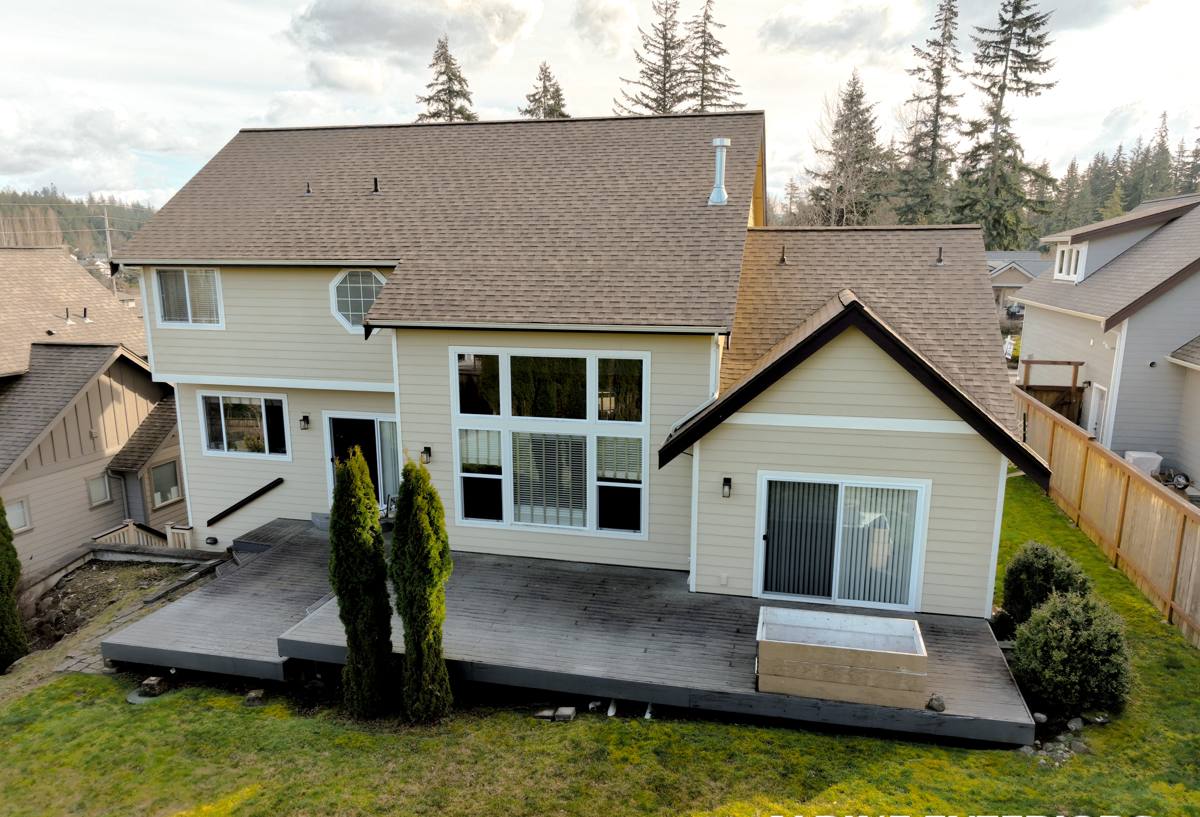
What Salt Air, Rain, and Moss Actually Do to Siding
Salt air
Airborne salt doesn't just sit on the surface. Over years it accelerates the breakdown of paint films, corrodes exposed fasteners, and speeds up wear on caulk and sealant joints — especially on walls facing the water or open to prevailing wind. Fastener corrosion is one of the more common root causes we find behind a section of siding that's failing faster than the rest of the house.
Driving rain
Whatcom County doesn't get gentle, straight-down rain most of the year — wind pushes it sideways into wall assemblies, which puts real pressure on laps, seams, butt joints, and anywhere trim meets siding. If those details weren't installed correctly the first time, or have opened up over the years, water gets behind the material instead of running off it. That's when you get hidden rot in the sheathing, not just a cosmetic mark on the surface.
Moss
Moss needs shade, moisture, and time to establish, and Bellingham's climate hands it all three for most of the year. Once moss gets a foothold on a north-facing wall or anywhere airflow is poor, it holds moisture against the siding surface far longer than open, sunny walls ever see. On materials that aren't moisture-tolerant, that constant damp contact is where swelling, delamination, and soft spots start.
Signs Your Bellingham Home Needs Siding Repair
Most repair calls we get start with one of these observations. None of them mean the whole house needs new siding — but all of them are worth a real inspection rather than a wait-and-see approach.
- Soft, spongy, or visibly bowed sections when pressed by hand
- Persistent moss or algae growth that comes back within weeks of cleaning
- Staining or dark streaking below seams, trim, or window heads
- Visible gaps opening up at butt joints, corners, or where siding meets trim
- Peeling or bubbling paint concentrated in one area rather than spread evenly
- A musty smell near an exterior wall, or a noticeable draft indoors near that wall
- Rust streaks below fasteners or corner flashing
A single symptom on its own isn't necessarily urgent. Two or three of these together, especially in the same section of wall, usually mean water has been getting behind the siding for a while and the visible damage is just the part you can see.
What a Correct Repair Actually Involves
A repair that just covers up the visible problem tends to fail again within a season or two, because it doesn't address what let water in the first place. A repair worth paying for includes:
- Removing enough surrounding material to see the actual extent of the damage, not just the failed piece itself — damaged sheathing or house wrap hides behind good-looking siding more often than people expect.
- Checking the water-resistive barrier and flashing details at the point of failure. If the underlying moisture management wasn't right, replacing the siding alone just resets the clock.
- Addressing rot or soft sheathing before anything new goes back on. Covering rotten wood with new siding is a short-term fix that guarantees a repeat call.
- Matching or replacing fasteners appropriately — corroded fasteners get replaced with corrosion-resistant hardware suited to a coastal-influenced climate, not just swapped one-for-one.
- Re-detailing the joints and laps so water sheds correctly, accounting for the direction that wind-driven rain tends to hit that particular wall.
Skipping any of those steps is how a homeowner ends up paying for the same repair twice.
Repair or Replace? How We Make That Call
Not every damaged section needs a full re-side, and we don't push replacement when a proper repair will genuinely hold. The honest answer depends on how much of the wall is affected and what's driving the damage.
| Factor | Favors Repair | Favors Replacement |
|---|---|---|
| Extent of damage | Isolated to one wall or section | Recurring across multiple walls |
| Underlying sheathing | Sound once opened up | Widespread rot or soft spots |
| Age of existing siding | Well within its expected life | Near or past its practical lifespan |
| Root cause | A single failed detail (one joint, one flashing) | Systemic moisture intrusion or original installation errors |
| Material match | Discontinued but patchable | Discontinued and visually mismatched |
We'll tell you plainly which side of that table your house falls on. If a repair is the honest answer, that's what we'll quote — a repair-focused local business doesn't stay in business by talking people into work they don't need.
Why We Repair With James Hardie Fiber Cement
When a repair calls for new material — not just re-sealing or refastening existing siding — we install James Hardie fiber cement, because that's the only siding product we install, full stop. We don't stock or install LP SmartSide, vinyl, Cemplank, Allura, or primed wood, so if a section needs to be cut out and replaced rather than repaired in place, it gets replaced with Hardie board matched as closely as possible to the existing profile and color.
There's a practical reason this matters specifically for repair work in a climate like Bellingham's: fiber cement doesn't absorb and hold moisture the way wood-based products can, and it isn't vulnerable to the heat and impact sensitivity that comes with some other claddings. In a wall assembly that already had a moisture problem once, patching it with a material that handles Bellingham's rain and moss season better than the original is a straightforward upgrade, not an upsell. Hardie's HZ5 product line is engineered for wetter climate zones, and its factory-applied ColorPlus finish resists the fading and moss-friendly surface breakdown that bare or field-painted materials are more prone to over time.
To be direct: we're not going to tell you a competing product is garbage. Vinyl, LP, and others all have their place and their advocates. We simply made a standard for our own crews — one product, installed to spec, backed by one warranty structure — and that standard is what goes on a house whenever we're the ones doing the work, repair or full replacement.
Our Process for a Bellingham Repair Call
- On-site inspection of the damaged area and the wall assembly around it, not just the spot you called about
- Honest diagnosis of the root cause — flashing, caulking, fastener corrosion, moss retention, or an original installation gap
- Written scope and estimate that specifies repair vs. replacement and why, in plain language
- Removal and inspection of sheathing once the damaged siding is off, before anything new goes on
- Correct re-detailing of flashing, laps, and joints for the specific wall and exposure
- James Hardie material installed to manufacturer spec wherever new siding is needed
- Cleanup and a final walk-through so you can see exactly what was done and why
Why a Crew That Already Works Bellingham Matters
Siding repair done wrong in this climate doesn't announce itself right away — it shows up as a callback eighteen months later. A crew that regularly works in Bellingham and the surrounding Whatcom County area has already seen how salt air, driving rain, and moss behave on this specific coastline, on this specific building stock, across enough houses to recognize patterns instead of guessing. That familiarity shows up in small decisions — which fastener spec to use, how much overlap a lap joint needs on a wall that takes wind-driven rain head-on, where moss is likely to come back even after a clean repair — that a crew unfamiliar with the area might not think to account for.
It also means fewer surprises on scheduling and permitting, and a contractor who's answerable locally if a question comes up after the work is done, rather than a crew that did one job in the area and moved on.
Keeping Your Siding in Good Shape After the Repair
A correct repair buys you years, but a little ongoing attention keeps it that way in a climate that never really stops working against your siding:
- Keep gutters clear so overflow doesn't run down the wall face during heavy rain
- Trim back vegetation and tree cover that keeps a wall shaded and damp longer than it needs to be
- Rinse off moss and algae buildup before it has time to establish a real foothold
- Check caulking at trim and joints every couple of years, since sealant is the first thing to wear out
- Walk the exterior after major storms and note anything that looks different from last season
None of that requires special equipment or a contractor visit every time — it's mostly a matter of not letting small issues sit through another wet Whatcom County winter.
If you're seeing soft spots, recurring moss, staining, or gaps on your Bellingham home, we're happy to take a look and give you a straight answer on repair versus replacement — no pressure, no upsell, just what the wall actually needs. Fill out the form below for a free estimate.