 Lynden Window
 Ferndale's Exterior Walls Work Harder Than Most
Ferndale sits close enough to Puget Sound and Bellingham Bay that salt-laden air is a constant, low-grade stress on anything nailed to the outside of a house. Add Whatcom County's long wet season, frequent wind-driven rain, and shaded, slow-drying north sides of roofs and walls, and you get a climate that is genuinely tougher on siding than most of the country ever sees. Moss and algae get a long runway to establish themselves — often eight or nine months a year in shaded spots — and once they take hold, they hold moisture against the wall surface long after the rain has stopped.
None of this means siding is doomed to fail. It means siding needs to be installed correctly for this climate in the first place, and repaired by people who understand why it failed, not just what it looks like on the surface. That's the gap we see most often on repair calls in Ferndale: a patch job that covers up staining or a soft spot without ever addressing the moisture path that caused it.
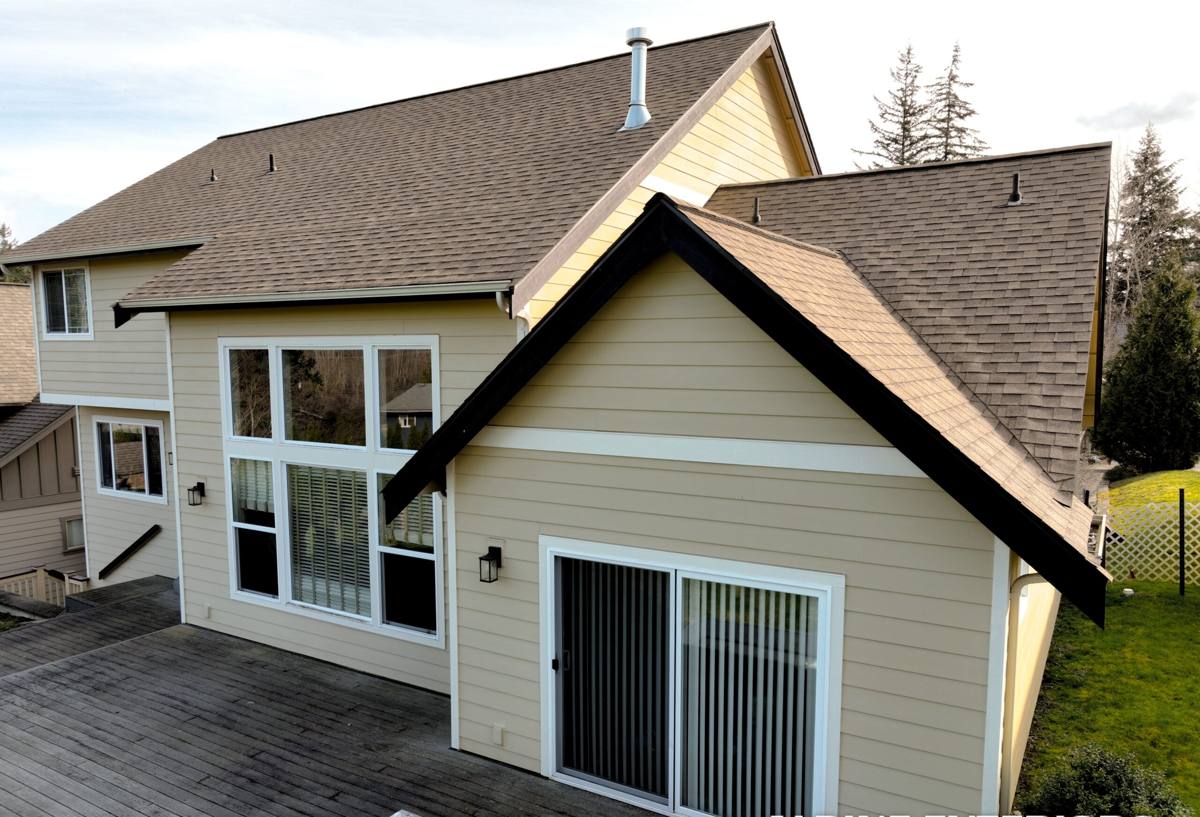
Signs a Ferndale Home Needs Siding Repair
Some damage is obvious. Some isn't visible until you know where to look. On a typical Ferndale property, we watch for:
- Soft, spongy, or visibly swollen siding panels, especially near the bottom courses and around window and door trim
- Persistent dark staining or streaking that doesn't wash off with normal rain
- Thick moss or algae growth on north- and west-facing walls, particularly under overhangs and near mature trees
- Bubbling, peeling, or chalking paint that keeps coming back in the same spots year after year
- Gaps opening up at seams, corner boards, or where siding meets trim, flashing, or the foundation
- Visible warping, cupping, or separation of individual boards or panels
- A musty smell or discoloration on interior walls that back up to an exterior wall with siding problems
Any one of these on its own might be minor. Several showing up in the same area of the house usually points to a moisture problem that's been building for a while, not a one-time event.
What a Correct Repair Actually Involves
Diagnosing the Cause, Not Just the Symptom
Cutting out a damaged section and nailing up a patch is the easy part. The part that actually prevents the problem from coming back is figuring out why that section failed in the first place. That usually means checking the flashing above windows and doors, the condition of the water-resistive barrier behind the siding, the grade and drainage right at the wall, and whether gutters or downspouts have been dumping water somewhere they shouldn't. In a lot of the repair calls we run in Ferndale, the siding itself is the visible casualty — the real cause is a small flashing gap or a clogged gutter that's been feeding water into the wall assembly for a season or two.
We don't close a wall back up until we know that cause has been fixed. A cosmetic repair over an unresolved moisture path just buys a homeowner a year or two before the same spot fails again, often worse.
Matching Materials and Finish
Repair work also has to match what's already on the wall — profile, reveal, and color — closely enough that the patch doesn't stand out like a scar. That's straightforward when the existing siding is a factory-finished product with a documented color and profile. It gets harder with older or weathered material where the original finish has faded unevenly, or where the exact profile is no longer made. In those cases we're honest with homeowners about the options: a close-but-not-perfect match on a small repair, or a broader section replacement so the color and texture are consistent across the whole elevation.
Repair vs. Replacement: How We Help You Decide
Not every damaged section needs to become a full re-side. But sometimes a spot repair is a short-term fix on a wall that's already past its useful life. Here's the general framework we walk homeowners through:
| Situation | Repair usually makes sense | Replacement usually makes sense |
|---|---|---|
| Extent of damage | Isolated to one or two boards or panels | Spread across multiple walls or elevations |
| Age of existing siding | Well within its expected service life | Near or past the end of its expected life |
| Cause of failure | A specific, fixable event (flashing gap, impact damage) | A systemic issue — chronic moisture, widespread moss, material breakdown |
| Material match | Current profile and finish still available | Original product discontinued or badly faded |
| Underlying assembly | Water-resistive barrier and sheathing sound | Sheathing or barrier compromised behind multiple areas |
We'll always give a straight answer on which side of that line your house falls on. There's no benefit to us talking a homeowner into a full re-side when a targeted repair genuinely solves the problem — and no benefit to patching a wall that's going to need replacing again in two years.
Why Our Repairs (and Replacements) Are James Hardie Fiber Cement
We install and repair one siding system: James Hardie fiber cement. We don't install vinyl, LP SmartSide, or cedar, and when a repair grows into a section replacement or a full re-side, Hardie is what goes back on the wall. In a climate like Ferndale's, that choice comes down to a few practical points:
- Non-combustible material that doesn't feed a fire the way wood-based or vinyl products can
- Engineered for wet climates — Hardie's HZ5 product line is specifically formulated for regions like ours with sustained moisture exposure
- Factory-applied ColorPlus finish that resists fading and doesn't need repainting on the same cycle as field-painted materials
- Dimensionally stable — it doesn't swell, cup, or warp with moisture the way wood-based composites can
- A strong transferable warranty backed by the manufacturer, not just the installer
None of that makes a Hardie repair immune to bad flashing or a buried gutter downspout — physics still wins if water is getting where it shouldn't. But it does mean the material itself isn't the weak link, which is more than can be said for some of the products we've chosen to stop installing.
Our Process for a Ferndale Siding Repair Call
- On-site inspection of the damaged area and the surrounding wall assembly, including flashing, trim, and drainage
- A straight assessment of cause — not just what's damaged, but why
- A written estimate that separates the repair scope from any recommended fixes to the underlying cause (flashing, gutters, grading)
- Material sourcing and color matching before any cutting begins, so there are no surprises at install
- Repair or section replacement, with the moisture source addressed as part of the same visit whenever possible
- A final walkaround so the homeowner can see exactly what was done and why
We'd rather spend an extra ten minutes on the inspection than come back to the same wall next winter.
What Working Ferndale Regularly Adds
A crew that's spent time on Ferndale roofs and walls has a feel for the patterns specific to this stretch of Whatcom County — which elevations tend to hold moss the longest, how far salt air travels inland from the water, and how local drainage and tree cover shape where moisture problems show up first. That's not something you can fully substitute with a one-time visit from a crew based somewhere drier. It shows up in small ways: knowing to check a particular flashing detail first, or recognizing early-stage moss growth before it's had a chance to hold water against the wall for a full wet season.
Maintaining Siding After the Repair
A good repair holds up longer with a little routine attention, especially given how long our moss season runs:
- Keep gutters and downspouts clear so water isn't overflowing onto the wall below
- Trim back vegetation that's shading a wall and keeping it from drying out between rains
- Rinse off heavy moss or algae buildup before it has a chance to work into seams and joints
- Do a visual walk of the exterior once or twice a year, checking the same trouble spots — window and door trim, corner boards, bottom courses
- Address small caulking or trim gaps early, before the next wet season turns them into bigger problems
If you're seeing staining, soft spots, moss buildup, or gaps in your siding anywhere on your Ferndale property, we're happy to take a look and give you a straight read on what's going on and what it'll take to fix it properly. The estimate is free, there's no pressure to move forward, and you'll get an honest answer either way — use the form below to get in touch.