 Lynden Window
 Custer's Coastal Exposure and What It Does to Siding
Custer sits in the northwest corner of Whatcom County, close enough to Drayton Harbor, Semiahmoo Bay, and the Strait of Georgia that salt-laden air is a daily fact of life for anything mounted on the outside of a house. That's a different exposure than homes farther inland get. Salt air accelerates corrosion on fasteners, staples, and lower-grade trim hardware, and it works year-round, not just during storms. Combine that with driving rain that comes off the water sideways instead of falling straight down, and a wet season that runs long enough to give moss and algae months to establish themselves on shaded or north-facing walls, and you get a climate that's genuinely hard on exterior siding.
None of that is unusual for this part of Washington, but it does mean a siding system that works fine in a drier inland climate can fail early here. Wood-based products absorb moisture and swell, weak paint systems chalk and fade faster under salt exposure, and anything that traps water behind it turns into a rot problem within a few wet seasons. Fiber cement siding, installed correctly, handles all three of those stresses better than the alternatives, which is why it's the only material we put on homes in this area.
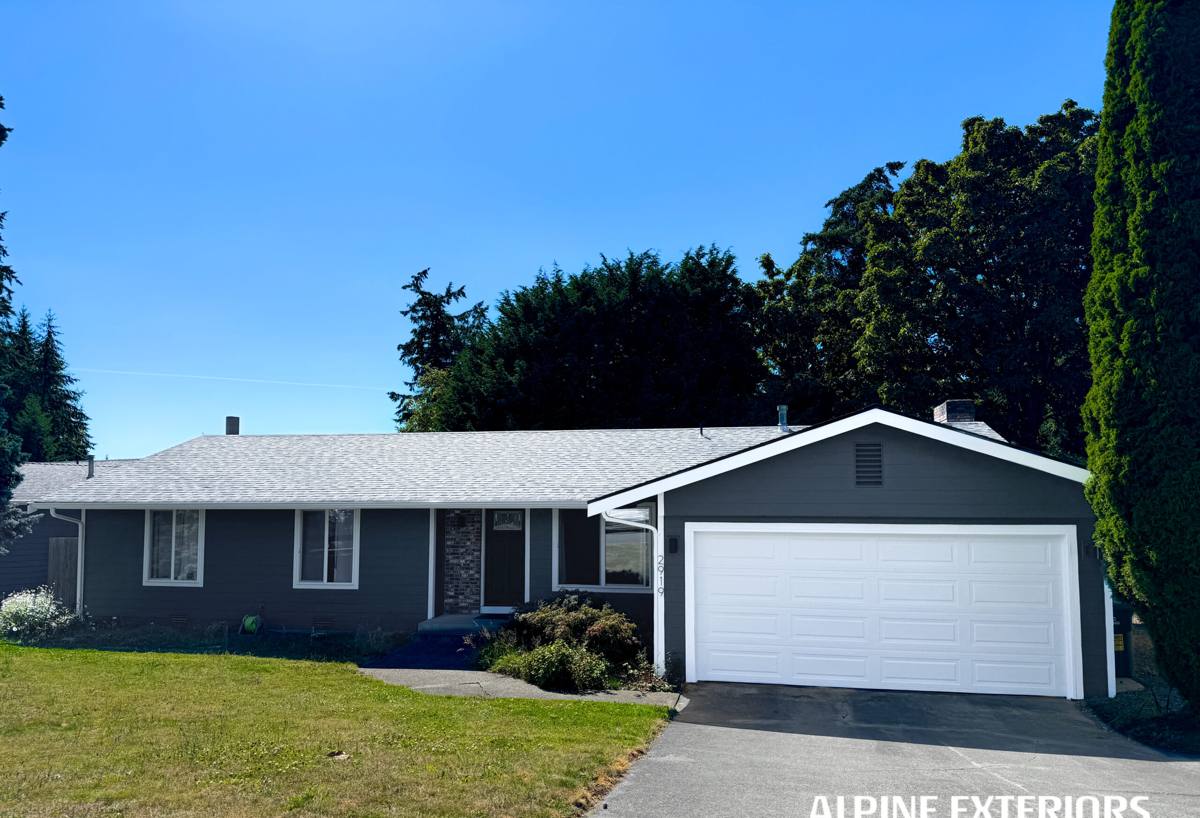
Why Fiber Cement Is the Right Material for This Climate
It Doesn't Absorb and Swell Like Wood-Based Products
Fiber cement is made from cement, sand, and cellulose fiber, not wood pulp or wood strand. That composition means it doesn't swell, delaminate, or lose structural integrity the way wood-based siding can when it takes on repeated moisture. In a climate where wall surfaces stay damp for extended stretches through fall and winter, that difference matters more than most homeowners realize until they've dealt with a siding product that didn't hold up.
It Resists Moss and Algae Better Than Most Alternatives
Moss and algae need a damp, organic surface to establish themselves on. Fiber cement's surface doesn't feed growth the way wood or some composite products can, and a factory-applied finish adds another layer of resistance. It's not immune to growth in a heavily shaded, poorly ventilated spot, but it holds up noticeably better over a multi-year moss season than materials with more absorbent or organic surfaces.
It's Non-Combustible
Fiber cement doesn't burn. That's a meaningful safety difference from vinyl, which can melt and deform under heat, and from wood-based siding, which is combustible by nature. It's not the primary reason most Custer homeowners choose it, but it's a real advantage worth knowing about.
Why We Only Install James Hardie Fiber Cement
Not all fiber cement is the same, and we've settled on James Hardie as our standard after years of installing it and other products across Whatcom County. That's a professional decision, not a sales pitch, and it's worth explaining honestly rather than just asserting it.
We don't install vinyl siding, LP SmartSide, cedar, or primed spruce, and each has a real reason behind it. Vinyl is affordable and low-maintenance, but it can warp or crack under temperature swings and impact, its color is baked into a thinner material that fades over time, and it doesn't offer the same fire performance as fiber cement. LP SmartSide is a wood-strand product with an engineered coating; it performs reasonably well when installation details are followed exactly, but it's still wood-based at its core, which means it's more sensitive to sustained moisture exposure than fiber cement, and that's a real liability in a climate this wet. Cedar and primed spruce look good on day one, but they demand an ongoing maintenance schedule — restaining, repainting, caulking — that most homeowners underestimate, and any lapse in that schedule shows up fast in a climate with this much rain and salt air.
James Hardie's specific advantage is the ColorPlus factory finish, a baked-on, multi-coat finish applied under controlled conditions rather than painted on site after installation. It resists fading and chipping better than field-applied paint, and Hardie backs it with its own finish warranty separate from the product warranty. Combined with a transferable limited warranty on the siding itself, that gives Custer homeowners a documented, manufacturer-backed standard instead of a promise built entirely on a contractor's word.
| Material | Moisture Behavior | Salt Air / Coastal Durability | Maintenance | Fire Rating |
|---|---|---|---|---|
| James Hardie Fiber Cement | Doesn't swell or delaminate | Strong; factory finish resists fading and chipping | Low; occasional wash | Non-combustible |
| Vinyl | Doesn't absorb, but can warp under heat | Color fades faster under sustained UV and salt | Low, but limited repair options | Can melt/deform |
| LP SmartSide | Wood-strand core; moisture-sensitive at cut edges and seams | Moderate; depends heavily on correct install and caulking | Moderate; edge sealing upkeep | Combustible |
| Cedar / Primed Spruce | Absorbs moisture; prone to swelling and rot if unmaintained | Weak without a strict refinishing schedule | High; regular refinishing required | Combustible |
The Hardie Product Lines We Use in Custer
Custer falls within the HZ5 climate zone in Hardie's engineered product system, which is formulated for regions with sustained moisture, freeze-thaw cycling, and coastal exposure — a good match for what this area's weather actually delivers. On most projects we use HardiePlank lap siding in a traditional or beaded profile, paired with HardieTrim for corners, window and door casings, and fascia, and HardieSoffit where ventilation and eave detailing call for it.
ColorPlus vs. Field-Applied Paint
Most Custer homeowners choose a ColorPlus factory finish rather than field-applied paint. Beyond the color consistency, ColorPlus panels come with factory-matched touch-up products and trim, which keeps color uniform across the whole exterior — something that's harder to guarantee when paint is mixed and applied on site over multiple days.
Plank Width and Profile
Plank exposure width and profile are mostly an aesthetic choice, but they do affect how the finished wall reads from the street and how shadow lines fall across the surface. We'll walk through the available options against your home's style rather than defaulting to a single look.
What Correct Installation Actually Involves
Fiber cement's performance depends heavily on installation quality — that's true of almost any siding product, but it's especially true in a climate that gives every gap or shortcut months of wet weather to find. A correct installation includes:
- A drainage plane and, on most walls, a rainscreen gap that lets any moisture that gets behind the siding drain and dry instead of sitting against the sheathing
- Properly lapped and sealed weather-resistant barrier under the siding, tied correctly into window and door flashing
- Fastener spacing and placement that follows Hardie's published installation specs, since incorrect nailing is one of the most common causes of early siding failure and can void the product warranty
- Correctly sized gaps at butt joints and trim, sealed with a high-quality, paintable sealant rated for exterior use
- Flashing at every horizontal trim board, window head, and roof-to-wall transition, since these are the spots where water intrusion actually starts
- Kick-out flashing at rooflines that terminate into a sidewall, redirecting water away from the siding below instead of letting it run down behind it
Skipping any one of these doesn't necessarily cause an immediate problem — it usually shows up two or three wet seasons later, as buckling, staining, or rot in the sheathing behind the siding. That delay is exactly why installation quality is worth scrutinizing before a project starts, not after.
Our Process, Start to Finish
- Site visit and assessment — we look at your home's current siding, wall assembly, and specific exposure (shade, wind direction, proximity to open water) before recommending anything.
- Product and finish selection — we walk through plank profile, color, and trim options based on your home's style and your budget.
- Written estimate — a clear scope of work and price, with the installation details spelled out, not left vague.
- Tear-off and wall prep — removing old siding, inspecting sheathing for hidden rot or damage, and repairing anything we find before new siding goes on.
- Weather barrier and drainage plane installation — the layer that does the real long-term moisture protection work, installed and detailed correctly the first time.
- Siding, trim, and flashing installation — following Hardie's fastening and clearance specs throughout.
- Final walkthrough — we go over the finished work with you before calling the job complete.
Cost Factors for a Custer Fiber Cement Project
Every project is different, and we won't quote a number without seeing your home, but these are the main factors that move a project's cost up or down:
| Factor | How It Affects Cost |
|---|---|
| Home size and wall complexity | More square footage and more corners, gables, and dormers mean more material and labor time |
| Tear-off vs. new construction | Removing and disposing of existing siding, and repairing any sheathing damage found underneath, adds cost over a bare-wall install |
| Plank profile and finish | Wider exposure profiles and certain ColorPlus colors can carry different material pricing |
| Trim scope | Full trim replacement with HardieTrim costs more than reusing sound existing trim where it makes sense to do so |
| Access and site conditions | Multi-story walls, tight lot lines, or limited equipment access can add labor time |
Keeping Moss and Salt From Winning Long-Term
Fiber cement needs far less upkeep than wood-based siding, but a little attention keeps it looking right for decades in this climate:
- Rinse siding down once or twice a year, especially on shaded or north-facing walls, to keep moss and algae from establishing
- Keep gutters clear so overflow doesn't run down the wall face and stay wet longer than it should
- Trim back vegetation and tree limbs that shade a wall and slow drying after rain
- Check and re-caulk joints and trim seams every few years, since sealant is the one component that wears out before the siding itself does
- Have a professional look at any area showing persistent staining, dark streaking, or a soft spot in the trim before it turns into a bigger repair
If you're weighing a siding replacement for a Custer home and want a straightforward, honest read on what your house actually needs, we're glad to take a look. Reach out using the form below to schedule a free, no-pressure estimate.