 Lynden Window
 Why Roofs in Acme Wear Differently Than Roofs Inland
Acme sits in the foothill corridor east of Lynden, where Whatcom County's marine weather collides with terrain that pushes rain up and over the roofline instead of just down onto it. That combination matters more than most homeowners realize. The moisture-laden air that rolls in off Bellingham Bay and the Salish Sea travels inland on prevailing winds, and by the time it reaches Acme it's still carrying enough salt and dampness to accelerate corrosion on fasteners, flashing, and exposed metal. Add in driving, wind-pushed rain that hits roof planes at an angle instead of falling straight down, and you get moisture finding its way under shingle edges and around penetrations that would stay dry in a calmer climate.
Then there's the shade. Homes tucked against tree lines or set back from open sun get long stretches of the year where a roof simply doesn't dry out between rain events. That's the recipe for moss, and Whatcom County's moss season isn't a few weeks — it's most of the year in shaded pockets. A roof replacement done right here isn't the same job as one done in a drier, flatter part of the state. It has to account for how water moves across the roof, how long it sits there, and what it's carrying with it.
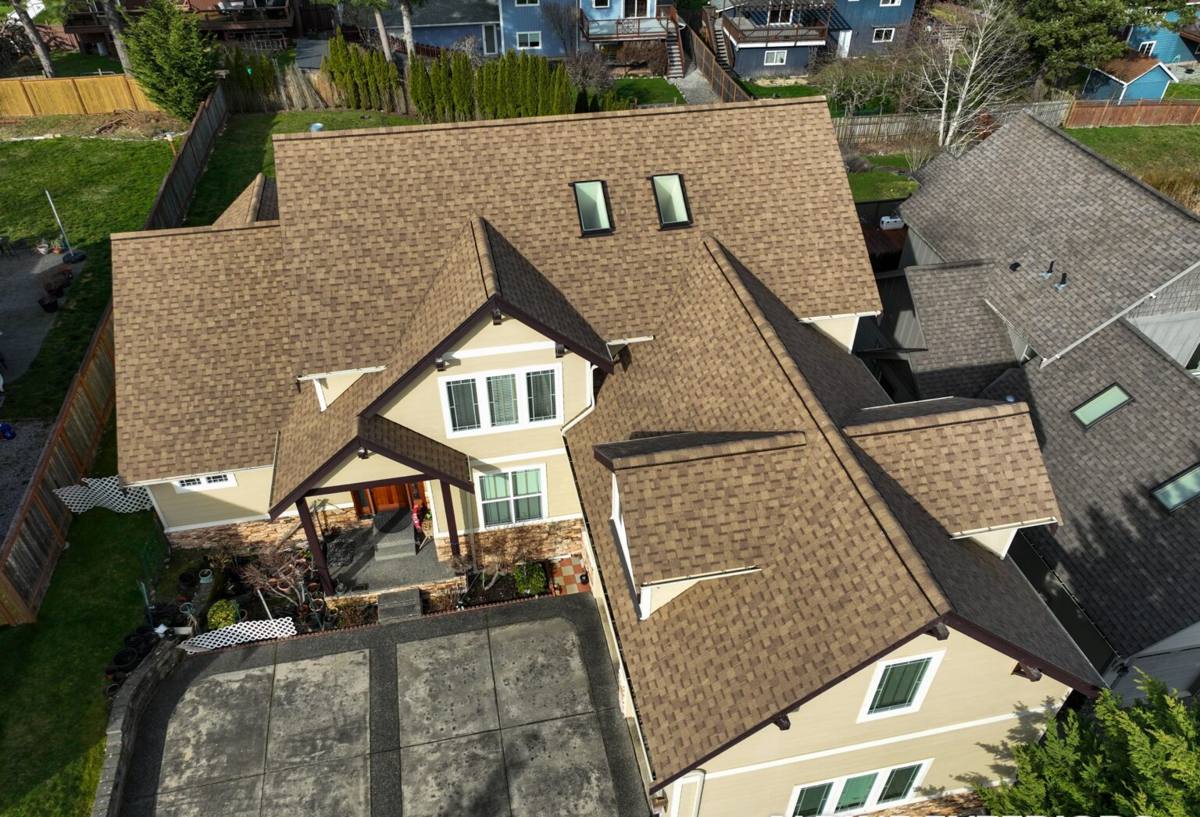
What a Correct Roof Replacement Actually Involves
"Roof replacement" gets used loosely, but a proper tear-off-and-rebuild has specific steps that protect the house for the next 25-40 years, not just the next few winters. Skipping any of these is how a roof looks fine at installation and fails early.
Full Tear-Off, Not an Overlay
We remove the existing roofing down to the deck rather than layering new shingles over old ones. An overlay traps moisture that's already worked its way into the old layer, and it hides deck damage that needs to be caught and repaired before new material goes down. In a climate that stays damp as long as ours does, hidden rot under an overlay is a matter of when, not if.
Deck Inspection and Repair
Once the old roofing is off, the sheathing gets inspected board by board. Soft spots, delamination, or fastener pull-through get replaced before anything else happens. This step is also where we find out whether ventilation problems have already caused deck damage — something you can't see from the ground or even from inside the attic in every case.
Ice-and-Water Barrier at Vulnerable Points
Eaves, valleys, and penetrations (plumbing vents, chimneys, skylights) get a self-adhered waterproof membrane underneath the primary underlayment. This is the layer that stops wind-driven rain from working backward under shingles at the edges — the exact failure mode our weather pattern causes most often.
Synthetic Underlayment Across the Field
Over the rest of the deck, a synthetic underlayment provides a second line of defense and holds up far better than old-style felt paper in a climate where the roof deck stays damp for long stretches during installation and afterward.
Flashing Done Right, Not Reused
Step flashing, counter-flashing, and valley metal get replaced, not caulked and reinstalled. Reused flashing is one of the most common sources of leaks we find on "recently replaced" roofs — it looks fine but no longer seals the way new metal does.
Ventilation Balanced, Not Just Added
Intake at the eaves and exhaust at the ridge need to work together. Adding ridge vent without enough intake, or vice versa, can actually make moisture problems worse instead of better.
Material Choices for This Climate
There's no single "best" roofing material — the right choice depends on how much shade the roof gets, how steep it is, and what the homeowner wants to maintain long-term. Here's how the common options stack up for a shaded, damp, wind-exposed property typical of the Acme area.
| Material | Moisture & Moss Behavior | Wind/Rain Performance | Maintenance Reality |
|---|---|---|---|
| Architectural asphalt shingle | Algae-resistant granules help, but shaded areas still need periodic cleaning | Good wind rating when properly nailed and sealed | Low — occasional moss treatment, no special skills needed |
| Standing seam metal | Sheds moss well due to smooth surface and steep-slope-friendly install | Excellent in driving rain and wind once properly fastened | Low, but fastener and sealant points need occasional checks |
| Cedar shake | Requires the most active maintenance in a wet, shaded climate | Performs adequately but is sensitive to prolonged moisture exposure | Higher — regular treatment and inspection expected |
| Synthetic composite | Resists moisture absorption well; good moss resistance | Strong wind and impact ratings on most products | Low to moderate, product-dependent |
We don't push homeowners toward any one product. Our job is to walk through how much sun exposure the roof actually gets, what the budget looks like, and what kind of maintenance the homeowner is realistically willing to do, then match the material to those answers honestly.
Moss, Algae, and Long-Term Roof Health
Moss doesn't just look bad — it holds moisture against the roof surface, lifts shingle edges as it grows, and accelerates granule loss. In a region where shaded roofs can stay damp for months at a stretch, moss control has to be part of the plan from day one, not an afterthought tackled after problems show up.
Zinc or copper strips near the ridge are a simple, low-maintenance way to slow moss regrowth after replacement — rainwater carries trace metal ions down the roof plane and creates an environment moss doesn't like. We install these as standard practice on shaded roofs in this area because the alternative is a homeowner scheduling moss removal every year or two indefinitely.
What We Recommend Homeowners Do Between Services
- Keep gutters clear of needles and debris so water doesn't back up under the eave line
- Trim back overhanging branches where possible to reduce shade and debris buildup
- Never pressure-wash a roof — it strips granules and shortens shingle life
- Have moss physically removed (not just treated) if it's already established and thick
- Walk the attic once a year looking for daylight, staining, or damp insulation near penetrations
Signs an Acme Home Needs Roof Replacement Soon
Roofs in this climate rarely fail all at once — they show warning signs for a season or two first. Catching these early is the difference between a planned replacement and an emergency one.
- Granules collecting in gutters or at downspout outlets
- Shingles that look curled, cupped, or have visibly darker patches from trapped moisture
- Moss or algae covering more than a small fraction of the roof plane, especially on north-facing sections
- Daylight visible through the roof deck from inside the attic
- Soft or spongy decking felt underfoot during any roof access
- Interior ceiling stains that appear or spread after wind-driven rain events
- A roof approaching or past 20-25 years old, regardless of visible condition
Any one of these on its own might not mean immediate replacement, but two or more together usually means it's time for an honest inspection rather than another patch repair.
How Our Process Works, Start to Finish
- On-site assessment. We walk the roof, check the attic, and look at gutters and fascia — the whole system, not just the shingles — before quoting anything.
- Written estimate with material options. You get a clear breakdown of what's included: tear-off, disposal, underlayment type, flashing, ventilation work, and material choice, with honest pricing rather than a vague lump sum.
- Scheduling around the weather. Roof replacement in a climate like ours means watching forecasts closely and sequencing tear-off so the deck isn't left exposed longer than necessary.
- Tear-off and deck repair. Old material comes off, the deck gets inspected, and any repairs happen before anything new goes down.
- Underlayment, flashing, and ventilation installed. This is the part of the job that's invisible once finished but determines how the roof performs in year 10, not just year one.
- Final material installation. Shingles, metal panels, or composite material go down to manufacturer specification — proper nailing patterns and exposure matter as much as the product itself.
- Cleanup and magnetic sweep. Job site debris and stray fasteners get cleared from the yard and driveway before we consider the job done.
- Final walkthrough. We go over the finished roof and attic with the homeowner before wrapping up.
Cost Factors Homeowners Should Understand
Every roof is priced individually, but the variables that move the number are consistent. Understanding them upfront makes it easier to compare estimates apples-to-apples.
| Factor | Why It Affects Price |
|---|---|
| Roof pitch and complexity | Steep or cut-up roofs (multiple valleys, dormers) take longer and need more safety setup |
| Layers to remove | Tear-off cost scales with how much old material and disposal weight is involved |
| Deck condition | Rotten or delaminated sheathing found during tear-off adds material and labor |
| Material selection | Asphalt, metal, and composite products carry different material and labor costs |
| Ventilation upgrades | Adding or correcting intake/exhaust venting is often necessary but not always in the original scope |
| Access and site conditions | Steep driveways, limited staging area, or tree cover near the roof affect crew time |
We'd rather walk through these line items with you than hand over a number with no explanation behind it. A roof is a major investment, and understanding what's driving the cost helps you make a decision you're comfortable with.
Why a Crew That Already Works Acme Matters
Roofing crews that only occasionally work this specific area sometimes underestimate how much moisture management matters here compared to drier parts of the state, or default to whatever underlayment and ventilation approach works fine elsewhere but underperforms in a climate this consistently wet and shaded. A crew that regularly works Acme and the surrounding Lynden area already knows which roof orientations tend to hold moss, which valleys collect debris fastest, and how local wind patterns drive rain into places a generic installation wouldn't account for.
That familiarity also shows up in smaller ways — knowing realistic weather windows for tear-off scheduling, understanding what permitting looks like through Whatcom County, and having a track record in the neighborhood that a homeowner can actually check on. It's the difference between a roof installed to a national average standard and one installed for the specific way weather behaves on your particular property.
Permits, Warranty, and What to Expect Timeline-Wise
Most roof replacements in unincorporated Whatcom County require a permit, and we handle that process as part of the job rather than leaving it to the homeowner. Manufacturer warranties on materials are separate from our workmanship warranty on installation — both matter, and we go over exactly what each one covers before work starts, since warranty terms vary meaningfully between manufacturers and material types.
A typical single-family roof replacement, once started, usually wraps up within a few days of active work, though scheduling around wet weather can extend the calendar time between contract signing and project start. We'd rather push a start date a few days for a dry weather window than rush a tear-off into a forecast that works against the job.
If your roof in Acme is showing its age, or you just want an honest read on how many years it has left, we're happy to take a look. Reach out for a free, no-pressure estimate — the form below gets you started.