 Lynden Window
 Birch Bay Sits Right at the Edge of Two Climates
Birch Bay homes get a version of Whatcom County weather that inland Lynden properties rarely see. Being this close to the water means salt-laden air moving onshore, wind-driven rain that hits walls sideways instead of falling straight down, and a longer wet season that gives moss and algae months to establish themselves on north-facing and shaded siding. Add in the wind that funnels along the shoreline during winter storms, and you have a set of conditions that will find every weak point in a siding system faster than they would ten or fifteen miles inland.
None of this means Birch Bay is a bad place to build or maintain a home — it means the siding has to be chosen and installed with these specific stressors in mind. A product and installation method that holds up fine in a sheltered inland yard can fail years early on a home exposed to salt air and driving rain. That's the entire reason we treat siding installation in Birch Bay as its own job, not a copy-paste of what we'd do elsewhere in Whatcom County.
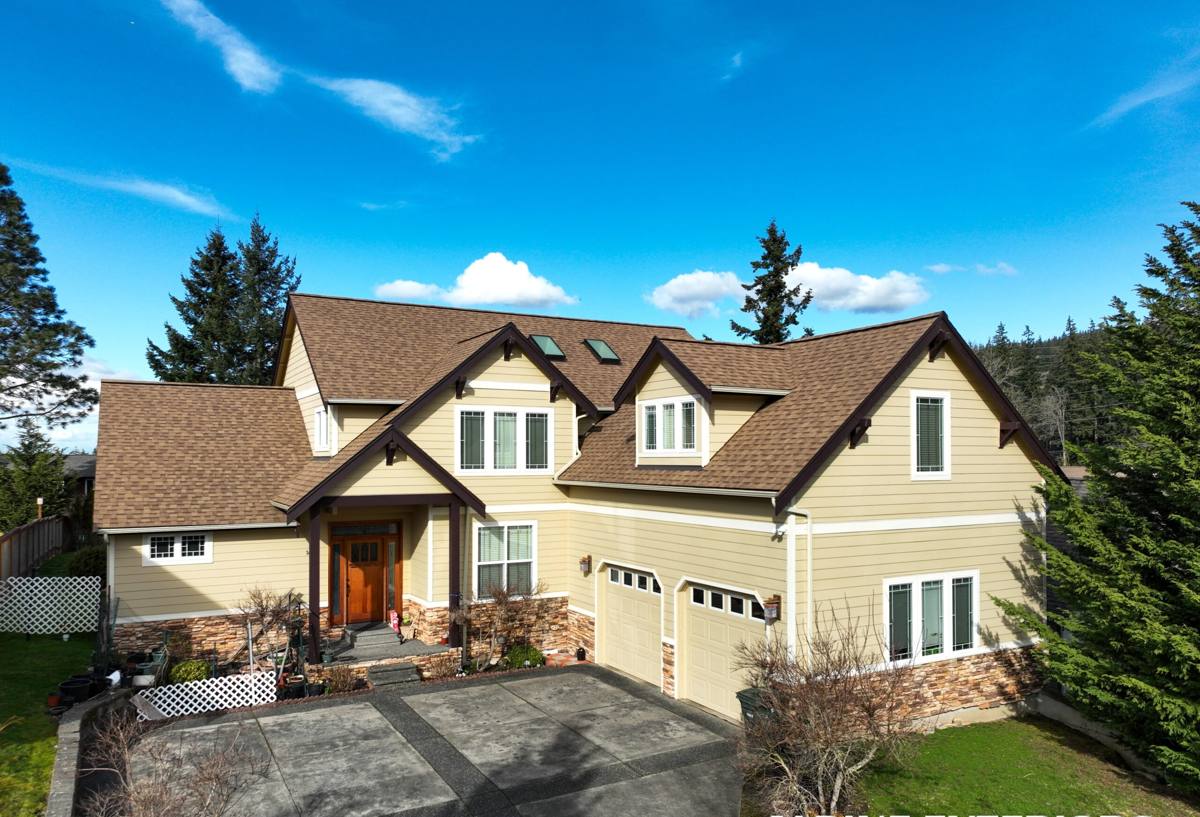
What Salt Air, Rain, and Moss Actually Do to Siding
It helps to understand the mechanisms, not just the symptoms.
Salt air
Airborne salt is corrosive to exposed metal fasteners, flashing, and trim, and it accelerates the breakdown of some paints and coatings. Over years, siding facing the water can show fading, chalking, or fastener corrosion well before the same product would on a sheltered inland wall.
Wind-driven rain
Ordinary rain falls down and sheds off a wall easily. Wind-driven rain hits siding at an angle and gets pushed into laps, seams, butt joints, and anywhere caulking or flashing is even slightly imperfect. This is why installation detailing — not just the material — determines whether water stays out.
Moss and algae
Shaded, north-facing, and tree-adjacent walls in this climate stay damp for extended stretches. Moss and algae need moisture and time, and Birch Bay's long wet season gives them plenty of both. Left unchecked, that growth holds moisture against the siding surface and can accelerate deterioration in materials that aren't rot-resistant.
| Material | Response to salt air | Response to wind-driven rain | Response to moss/algae |
|---|---|---|---|
| Vinyl | Doesn't corrode, but can fade and become brittle over time | Panels can be pushed by wind-driven water at seams if installed loose | Growth sits on the surface; doesn't feed on the material but holds moisture against the wall |
| Untreated or primed wood | Coatings degrade faster near salt air, exposing wood underneath | Very sensitive; trapped moisture leads to swelling and rot | Provides an organic surface moss and algae can actually feed on and root into |
| Engineered wood siding | Edge-sealing and coatings matter more near salt air | Manufacturer treatments help, but any breach at cut edges invites swelling | Resistant when properly sealed, but exposed or damaged edges are vulnerable |
| James Hardie fiber cement | Non-combustible cement composite; factory ColorPlus finish resists fading and chalking | Engineered for Pacific Northwest wet climates; performs well when laps and flashing are correct | Doesn't feed mold, mildew, or moss; growth can be surface-cleaned without damaging the material |
Why We Install Only James Hardie Fiber Cement Here
Lynden Window Co installs James Hardie siding exclusively. We don't install vinyl, LP SmartSide, Cemplank, Allura, primed spruce, or cedar, and in a place like Birch Bay that standard matters more than it might elsewhere. Fiber cement is a cementitious composite — it doesn't rot, it isn't a food source for moss or algae, and it doesn't warp or swell the way wood-based products can when they take on repeated moisture from wind-driven rain.
James Hardie also builds region-specific product lines engineered for exactly this kind of climate, and the factory-applied ColorPlus finish is baked on under controlled conditions rather than field-painted, which gives it better resistance to the fading and chalking that salt air accelerates in site-applied coatings. That combination — a non-combustible material that doesn't rot or feed organic growth, paired with a finish designed to hold its color near the water — is why we stopped installing the alternatives and standardized on Hardie for every home we side, waterfront or not.
We're not suggesting other products are worthless; vinyl and engineered wood sidings have real uses and reasonable track records in sheltered settings. But once you're weighing decades of exposure to salt air and wind-driven rain, we'd rather put a material on your walls that's built for it than one that needs the weather to cooperate.
What a Correct Installation Actually Involves
The material is half the equation. The other half is installation detail, and this is where a lot of siding jobs — regardless of product — quietly fail years later. In a wind-driven-rain environment like Birch Bay, these details aren't optional extras:
- Weather-resistive barrier: A continuous, properly lapped moisture barrier behind the siding, with every penetration sealed, is the last line of defense if water gets past the cladding.
- Rainscreen gap: A drainage gap between the siding and the wall assembly lets any moisture that does get behind the panels drain and dry out instead of sitting against the sheathing.
- Flashing at every horizontal transition: Windows, doors, decks, and roof-to-wall intersections need flashing detailed to shed water outward, not just caulk relied on to hold it back.
- Correct fastening: James Hardie specifies fastener type, spacing, and placement for a reason — under-driven or over-driven nails, or fasteners in the wrong location, create the exact weak points wind-driven rain will exploit.
- Sealed cut edges: Any field-cut piece needs its edge treated per manufacturer instructions before installation, particularly at butt joints and corners.
- Proper clearance at grade and hardscape: Siding needs to end well above grade, decks, and patios so it isn't sitting in splash-back moisture.
Skip any one of these and the siding itself becomes almost irrelevant — water will find the gap.
Our Process for a Birch Bay Siding Installation
- On-site assessment: We walk the exterior, checking current siding condition, trim, window flashing, and any signs of past moisture intrusion — paying particular attention to north-facing and water-facing walls.
- Removal and sheathing check: Old siding comes off and we inspect the sheathing underneath for rot or soft spots before anything new goes up. This is often where hidden problems from a prior installation surface.
- Moisture barrier and rainscreen installation: We install a continuous weather-resistive barrier and drainage gap system suited to the wall assembly.
- Flashing details: Windows, doors, and all horizontal penetrations get flashed before siding installation begins, not patched afterward.
- James Hardie installation to spec: Panels, planks, or shingles are installed following manufacturer fastening, clearance, and joint-treatment requirements.
- Trim, caulking, and final detailing: Corners, trim boards, and joints are finished and sealed per Hardie's installation guidelines.
- Final walkthrough: We review the completed exterior with you before considering the job done.
Signs Your Birch Bay Home May Need New Siding
- Persistent moss or dark streaking on north-facing or shaded walls that returns soon after cleaning
- Soft, spongy, or bubbling sections of siding, especially near the bottom courses or window trim
- Paint that's peeling, chalking heavily, or fading unevenly, particularly on water-facing elevations
- Visible gaps, warping, or separation at seams and butt joints
- Rusted or discolored fasteners showing through the surface
- Musty smells or interior moisture signs on exterior walls, which can point to a failed water barrier behind the siding
Cost Factors for Siding Installation in Birch Bay
Every home is different, and we'll give you real numbers after seeing the house, but these are the variables that move the price most:
| Factor | Why it matters |
|---|---|
| Home size and wall complexity | More corners, dormers, and trim details mean more cutting, fitting, and labor time |
| Current siding removal and disposal | Tear-off adds labor and disposal cost versus installing over new construction sheathing |
| Sheathing repair | Rot or soft sheathing discovered during removal needs to be repaired before new siding goes on |
| Product line and profile | Lap, shingle, and panel profiles, plus factory finish options, carry different material costs |
| Water-facing exposure | Elevations facing the bay may warrant additional flashing and drainage detailing |
| Access and site conditions | Slopes, tight lot lines, and staging space affect scaffolding and labor time |
Why Hiring a Crew That Already Works Birch Bay Matters
Siding installation isn't just following a manufacturer manual — it's applying that manual correctly to the conditions a specific wall will actually face. A crew that regularly works this stretch of Whatcom County shoreline already knows to prioritize drainage and flashing detail on water-facing walls, to expect longer wet-season drying times when scheduling work, and to check fastener condition and edge-sealing more carefully on homes that take direct salt air. That's not a marketing point — it's the difference between an installation that meets code and one that's actually built for where it sits.
We also stand behind our work with James Hardie's manufacturer backing, which includes a strong transferable warranty when the product is installed to specification. That warranty is only as good as the installation behind it, which is exactly why we're particular about how every detail — barrier, rainscreen, flashing, fastening — gets handled on every job.
Caring for Hardie Siding After Installation in a Coastal-Adjacent Climate
James Hardie siding is low-maintenance, not zero-maintenance. In Birch Bay's climate, a simple annual rinse-down of shaded and water-facing walls helps keep surface moss and salt residue from building up, and it's worth a quick visual check of caulking at trim and joints once a year, since sealant is the one component that does age faster than the siding itself. Beyond that, the material doesn't need repainting, sealing, or the recurring upkeep that wood-based sidings demand in this environment.
If you're planning a siding project for a Birch Bay home and want a straight answer about what your walls actually need, we're happy to take a look and walk the property with you. There's no pressure and no obligation — just a clear, honest assessment and a free estimate based on what we actually see on your home.