 Lynden Window
 Siding in Custer Has to Deal With a Tough Combination of Elements
Custer sits in a stretch of Whatcom County where a few different climate pressures overlap at once. You're close enough to the water to pick up salt-laden air rolling in off the Strait of Georgia and Birch Bay, you're in a corridor that gets pounded by driving, wind-blown rain for a good chunk of the year, and you're surrounded by the kind of shaded, moisture-holding conditions that keep moss and algae established on north-facing walls for months at a time. Any one of those on its own is manageable. Together, they're exactly the combination that wears out the wrong siding product fast and makes correct installation non-negotiable for the right one.
This page is about one job: installing siding on homes in and around Custer. Not a general overview of siding types, not a company pitch — just what local homes actually need from their siding, what a correct installation looks like out here, and why the crew doing the work matters as much as the material itself.
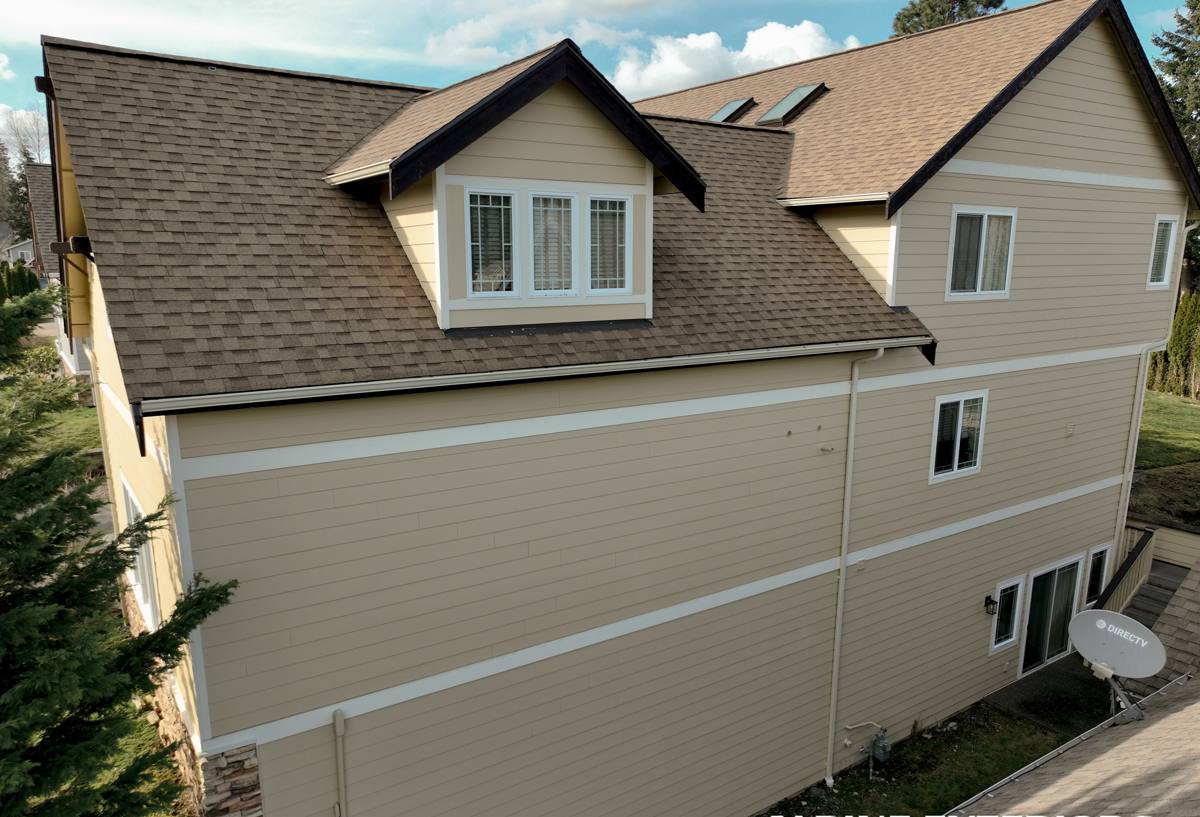
What Custer's Climate Does to Siding Over Time
Salt Air
Salt-carrying air doesn't just affect homes sitting right on the water. Wind can push that air well inland, and in a community like Custer — open farmland mixed with tree-sheltered lots, not far from the coast — it's common for exterior materials to see more airborne salt exposure than homeowners expect. Salt accelerates corrosion in fasteners and metal flashing, and it can speed up the breakdown of coatings and finishes that weren't engineered to handle it.
Driving Rain
Whatcom County doesn't get the heaviest rainfall totals in the state, but it gets a lot of wind-driven rain — the kind that hits siding at an angle instead of running straight down. That matters because wind-driven rain finds its way into laps, seams, and butt joints that would stay dry in a calmer climate. Siding and the water-resistive barrier behind it have to be installed with that reality in mind, not just installed to a generic spec sheet.
Moss and Algae Season
Between the tree cover common on many Custer lots and the long stretch of damp, overcast months, north- and east-facing walls stay wet longer than they do in drier climates. That's exactly the environment moss and algae need to take hold. Some siding materials resist that growth far better than others, and some finishes hold up to occasional cleaning far better than others.
Why We Install Only James Hardie Fiber Cement
We don't install vinyl, LP SmartSide, primed spruce, cedar, or other fiber cement brands like Allura or Cemplank. That's a deliberate standard, not a limitation of what we're capable of installing — we've simply concluded that James Hardie fiber cement is the product that holds up best to the specific conditions Custer and the surrounding Whatcom County area throw at a house, and we'd rather stand behind one product we trust completely than offer several we have reservations about.
- Non-combustible material — fiber cement doesn't feed a fire the way wood-based or vinyl products can.
- Engineered for Pacific Northwest moisture — Hardie's HZ10 product line is specifically formulated for wetter, more variable climates like ours, as opposed to their HZ5 line built for hot, dry regions.
- ColorPlus factory finish — a baked-on finish applied under controlled conditions, which holds color and resists fading and moisture intrusion better than field-applied paint.
- Dimensionally stable — fiber cement doesn't expand, contract, warp, or swell with moisture the way wood-based siding can, which matters a lot in a climate that cycles between soaked and dry.
- Strong transferable warranty — backed by Hardie directly, and structured to transfer to a new owner if the home sells.
None of this means other products are junk. Vinyl is inexpensive and low-maintenance in mild climates. Cedar has real aesthetic appeal and a long tradition in this region. LP SmartSide has improved a lot over the years. But each comes with a trade-off we're not willing to install and then have to answer for later — vinyl can warp and crack in temperature swings and offers little impact resistance; cedar demands ongoing maintenance and is vulnerable to moisture and pests without diligent upkeep; engineered wood products are more sensitive to installation errors and moisture exposure at the edges. In a climate like Custer's, those trade-offs show up faster than they would somewhere drier.
What Correct Siding Installation Actually Involves
The material is only half the equation. A lot of siding failures we get called out to inspect aren't a product problem — they're an installation problem. Correct installation in a high-moisture, wind-driven-rain climate means paying attention to details that are easy to skip and hard to see once the wall is closed up.
Water-Resistive Barrier and Flashing
Every wall needs a continuous water-resistive barrier behind the siding, with flashing detailed correctly at every window, door, and penetration so that any water that does get past the siding has a clear path back out — not into the wall assembly.
Proper Clearances
Hardie's own installation instructions specify minimum clearances from grade, roof lines, decks, and other abutting surfaces. Skipping these clearances is one of the most common causes of moisture damage at the bottom of a wall, and it's also one of the easiest things for an inexperienced crew to overlook under time pressure.
Fastening and Joint Treatment
Fasteners need to be the right type, spaced and set correctly, and driven into framing — not just sheathing. Butt joints and seams need to be treated according to spec, whether that's caulked, flashed, or backed, depending on the detail.
Ventilation Behind the Siding
A rainscreen or drainage gap behind the siding gives any moisture that gets past the cladding a way to drain and dry out, instead of sitting against the sheathing. This is especially valuable on shaded, tree-covered lots where walls stay damp longer.
Our Process for a Custer Siding Installation
- On-site assessment — we walk the exterior, check the current siding and sheathing condition, note trouble spots (shaded walls, low-clearance areas, existing moisture damage), and talk through what the home actually needs.
- Detailed estimate — a written scope covering removal, any sheathing or water-resistive barrier repair, the Hardie product and profile, and flashing details specific to your home.
- Tear-off and inspection — once old siding comes off, we inspect the sheathing underneath for rot or damage before anything new goes up. This is often where hidden moisture problems get found and fixed.
- Barrier and flashing installation — water-resistive barrier and flashing go in first, detailed around every opening and penetration.
- Hardie siding installation — installed to manufacturer spec, with correct fastening, clearances, and joint treatment throughout.
- Final walkthrough — we go over the finished work with you and address any questions before we consider the job done.
Comparing Siding Options for a Climate Like Custer's
| Factor | James Hardie Fiber Cement | Vinyl | Cedar | LP SmartSide |
|---|---|---|---|---|
| Salt air resistance | Strong, engineered finish | Fair, can chalk/fade over time | Fair, needs maintained finish | Fair, edge-sealing critical |
| Wind-driven rain tolerance | Strong when installed to spec | Moderate, seams can leak | Moderate, needs upkeep | Moderate, moisture-sensitive at cuts |
| Moss/algae resistance | Strong factory finish | Moderate | Low without treatment | Moderate |
| Combustibility | Non-combustible | Combustible | Combustible | Combustible |
| Maintenance burden | Low | Low | High | Moderate |
| Typical lifespan expectation | Long, warranty-backed | Moderate | Moderate with upkeep | Moderate |
These are general tendencies, not guarantees — installation quality affects every product on this list. But the pattern holds: the products that lean on ongoing maintenance or careful field detailing to perform well are the ones most likely to struggle in a climate that doesn't give a wall much time to dry out between storms.
Signs Your Custer Home's Siding May Need Attention
- Persistent moss or algae streaking on north- or east-facing walls that comes back quickly after cleaning
- Soft, spongy, or discolored spots, especially near the bottom of walls or below windows
- Visible warping, cupping, or gaps opening up at seams and joints
- Paint that's peeling, bubbling, or failing faster than a normal repaint cycle
- Rust staining around fasteners or trim
- Noticeably higher heating bills, which can point to a compromised weather barrier behind the siding
If you're seeing more than one of these, it's worth having someone take a real look rather than assuming it's cosmetic.
Why It Matters That We Already Work in This Area
Custer isn't a generic building site — it's a mix of open, wind-exposed farmland and tree-sheltered lots, sitting close enough to the coast that salt exposure is a real factor, all within a Whatcom County climate that stays damp for long stretches of the year. A crew that already works this part of the county knows which walls tend to hold moisture, which exposures need extra attention at flashing details, and how the local permitting and inspection process actually runs. That familiarity shows up in fewer surprises during the job and a longer-lasting result once it's done.
If you're weighing a siding replacement for a home in Custer or elsewhere around Lynden, we're happy to take a look and walk you through what we'd recommend — no pressure, no obligation. Reach out using the form below to set up a free estimate.