 Lynden Window
 Wiser Lake's Climate Is Harder on Siding Than Most Homeowners Realize
Homes around Wiser Lake sit in a pocket of Whatcom County where lake humidity and the marine-influenced air moving in off the Salish Sea combine into a genuinely tough environment for exterior materials. The lake itself keeps ambient moisture higher than you'd find further inland, shade from surrounding trees slows drying time after storms, and Whatcom County's long, wet fall-through-spring stretch means siding here rarely gets a real break to dry out completely.
That combination shows up as three specific problems on siding: prolonged surface dampness that feeds moss and algae, driving rain that gets forced sideways into laps and seams during winter windstorms, and cycles of swelling and drying that stress any material not built to handle repeated moisture exposure. Siding that would hold up fine in a drier part of the state can start failing years early out here.
Why This Matters Before You Pick a Material
A lot of siding failures we get called out to inspect at Wiser Lake properties aren't installation mistakes — they're material mismatches. Wood-based products absorb and release moisture with the seasons and eventually swell, cup, or rot at the edges. Vinyl doesn't rot, but it moves with temperature and can't be caulked or painted the same way, so gaps open over time and let moisture behind the panel. The material has to be chosen for this specific climate, not just for upfront cost.
What Fiber Cement Actually Solves Here
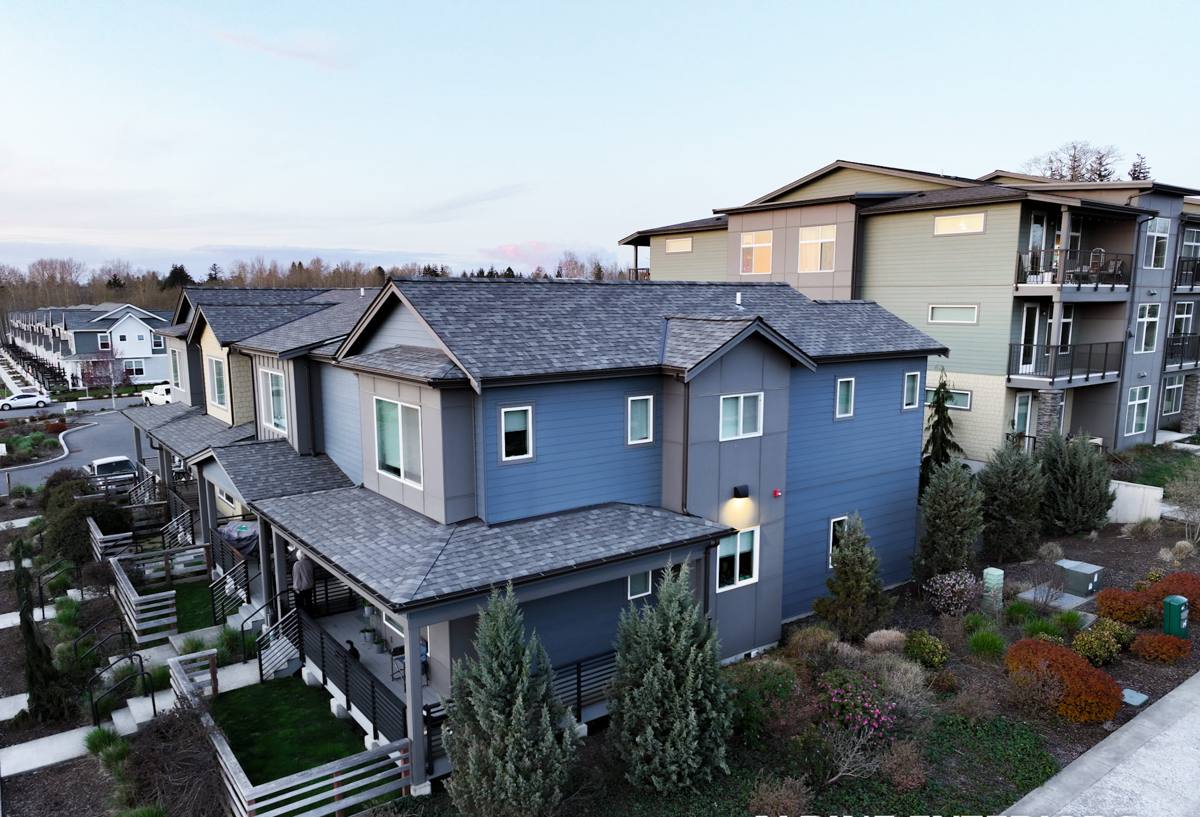
Fiber cement siding is cement, sand, and cellulose fiber formed under pressure into a dense, stable board. Because it isn't wood and isn't a thin extruded plastic, it doesn't absorb bulk water the way untreated wood does, and it doesn't expand and contract with temperature the way vinyl does. That stability is exactly what a long moss season and repeated driving rain call for — a material that isn't constantly moving or re-absorbing moisture between storms.
We install James Hardie fiber cement exclusively. Hardie's HZ5 formulation, engineered for the colder, wetter climate zones the Pacific Northwest falls into, and its factory-applied ColorPlus finish are built specifically around the freeze-thaw and moisture cycling that Whatcom County sees every winter. We'll get into why we don't install other fiber cement brands or wood/vinyl alternatives further down, but the short version is that the engineering behind the specific product matters as much as the general material category.
Where Fiber Cement Installations Go Wrong (And Why It Matters More at Wiser Lake)
Fiber cement is a forgiving, durable material — but only if it's installed correctly. In a damp, shaded environment like Wiser Lake, installation mistakes that might take a decade to show up in a drier climate can show up in two or three years. The most common failure points we see when we're asked to inspect or repair someone else's fiber cement job:
- Butt joints and seams caulked instead of properly flashed, letting water track behind the board during driving rain
- Panels nailed too tight against the house with no drainage gap, trapping moisture against the water-resistive barrier
- Bottom courses installed too close to grade, soil, or hardscaping, keeping the lowest boards perpetually damp
- Cut edges left unsealed at trim, corners, or penetrations, exposing raw fiber cement to standing moisture
- Fasteners driven incorrectly — overdriven, underdriven, or placed in the wrong zone of the board — which can crack the material or void the manufacturer warranty
None of these are visible from the street when a job is finished. They show up two, five, or ten years later as staining, soft spots, or moss establishing itself at the seams — which is often the first sign a homeowner gets that something was done wrong.
What a Correct Installation Involves at Wiser Lake
Building in Drainage From the Start
Every Hardie installation we do includes a drainage plane behind the siding — a water-resistive barrier plus furring or an integrated drainage wrap — so that any moisture that does get past the surface has somewhere to go besides sitting against the sheathing. In a lake-adjacent, shaded property, this isn't optional detailing; it's the difference between siding that dries out between storms and siding that never fully does.
Flashing Every Transition
Windows, doors, roof lines, and butt joints all get properly lapped, sealed flashing — not caulk alone. Caulk is a maintenance item that degrades in UV and temperature swings; flashing is permanent. Given how much driving rain gets pushed sideways into these transitions during Whatcom County's winter storm pattern, this step is where most long-term water intrusion problems get prevented or created.
Clearance and Grade Awareness
We keep the bottom edge of the siding at the manufacturer-specified clearance from grade, decks, patios, and roof lines, and we factor in how close a home sits to the lake and its landscaping. Homes with heavy shade or landscaping close to the foundation need extra attention here, since that's exactly where moss and mildew get their first foothold.
Correct Fastening and Cut-Edge Sealing
Every field cut gets sealed before installation, and fasteners go in per Hardie's specification for our exposure zone — not "close enough." This is also what keeps the manufacturer's warranty intact, which matters more in a wet climate where you're more likely to actually need it.
James Hardie Compared to Other Siding Options
| Material | Moisture Behavior | Maintenance Burden | Typical Longevity Here |
|---|---|---|---|
| James Hardie Fiber Cement (HZ5) | Dimensionally stable, engineered for wet/cold cycling | Repaint/recaulk on a long cycle; ColorPlus finish reduces this further | Decades when installed to spec |
| Vinyl Siding | Doesn't rot, but moves with temperature; seams can open over time | Low, but limited repair/refinish options once faded or cracked | Variable; UV and impact damage shorten lifespan |
| Primed Spruce / Cedar | Absorbs and releases moisture seasonally; prone to swelling and rot at edges | Frequent repainting and caulk maintenance | Shortened significantly in shaded, damp settings |
| Other Fiber Cement Brands | Similar base material, but formulation and finish quality vary by manufacturer | Depends on finish system and warranty structure | Depends heavily on product line and installation |
We don't install LP SmartSide, vinyl, Cemplank, Allura, or bare wood siding products. It's not that every one of these products is without merit — vinyl is genuinely low-maintenance in the right setting, and wood has an appearance some homeowners want. But in a climate like this one, we've made installing only James Hardie our professional standard because the combination of factory-cured ColorPlus finish, climate-specific HZ engineering, and Hardie's transferable warranty gives Wiser Lake homeowners the best long-term outcome we can put our name behind.
Our Process for a Wiser Lake Fiber Cement Project
- On-site assessment — we walk the exterior, checking existing siding condition, moss and moisture patterns, grade clearance, and shading before recommending anything.
- Product and profile selection — lap, shingle, or panel Hardie profiles, and ColorPlus color selection, matched to the home's exposure and your preferences.
- Tear-off and sheathing check — old siding comes off and we inspect the sheathing underneath for any hidden rot or damage before anything new goes on.
- Water-resistive barrier and drainage plane installation — the part of the job that never gets seen again, done to spec every time.
- Flashing and trim — windows, doors, corners, and roof transitions flashed before siding installation begins.
- Hardie installation — fastened, sealed, and spaced to manufacturer specification and our climate zone.
- Final walkthrough — we review the finished work with you and cover care and warranty registration.
Signs Your Current Siding May Already Be Struggling
- Moss or dark streaking concentrated at seams, butt joints, or the lowest courses
- Soft or spongy spots when pressed, especially near ground level or below windows
- Visible gaps or warping at panel joints after a few years
- Paint or finish failing faster than expected, particularly on shaded or lake-facing walls
- Interior signs like peeling paint or musty smell on exterior-facing walls
Any one of these on its own isn't necessarily an emergency, but on a Wiser Lake property where moisture has more time to work, they're worth having looked at before they become a sheathing problem.
Cost Factors Homeowners Should Know
| Factor | Why It Affects Price |
|---|---|
| Home size and number of stories | More square footage and staging/access complexity for taller walls |
| Existing siding removal and sheathing condition | Hidden rot found during tear-off adds repair scope |
| Siding profile and finish | Lap, shingle, and panel profiles, plus custom ColorPlus colors, price differently |
| Trim and detail work | Windows, corners, and architectural detailing add labor |
| Site access and landscaping | Lake-adjacent lots with mature trees or tight access can affect staging |
We give a firm, itemized quote after the on-site assessment rather than a ballpark over the phone — every Wiser Lake home we've looked at has had at least one detail (grade, shading, prior repairs) that changes the actual scope.
Living With Fiber Cement After Installation
One of the practical advantages of Hardie's factory-applied ColorPlus finish is that it's cured under controlled conditions before it ever reaches the house, which holds up better against the moss and mildew pressure common around the lake than a field-applied paint job. You'll still want to rinse the exterior periodically, especially on shaded sides, and keep an eye on landscaping so it isn't holding moisture against the bottom courses. Beyond that, fiber cement doesn't demand the recurring maintenance schedule that wood siding does.
Why a Crew That Already Works Wiser Lake Matters
Fiber cement installation isn't complicated in theory, but getting flashing, drainage, and clearance right for a specific property's exposure takes judgment that comes from having done it on similar homes nearby. A crew that already understands how Wiser Lake's shade patterns, lake humidity, and Whatcom County's storm direction interact with a house is going to make better calls on-site than one working from a generic spec sheet. That local familiarity is part of what you're paying for, alongside the material itself.
If you're weighing a siding replacement or just want an honest read on what's happening with your current exterior, we're happy to come take a look. Reach out for a free, no-pressure estimate — there's a form below to get started.