 Lynden Window
 Deming sits in the foothills east of Lynden, tucked along the Nooksack River corridor where the lowlands start climbing toward Mount Baker. That location is beautiful, but it's also demanding on outdoor structures. Heavier tree cover, more shade per square foot of yard, and a longer wet season than the open valley floor mean a deck built here has to work harder than one on a sunny in-town lot. A custom deck for a Deming property isn't just a Lynden deck moved up the highway — it needs to be planned around this specific setting from the first footing to the final board.
What Deming's Setting Does to a Deck
Whatcom County as a whole deals with driving rain, salt-tinged marine air off the coast, and a moss season that can run most of the year. In Deming specifically, the bigger factor is often tree canopy and river-valley humidity rather than open exposure. Properties backed up against timber or set along the Nooksack get less direct sun on their outdoor living space, which means slower drying after every rain event. Wood surfaces that don't get afternoon sun stay damp longer, and damp wood is exactly what moss, algae, and eventually rot need to take hold.
Add in the freeze-thaw swings that happen more sharply at slightly higher elevation and closer to the foothills than in Lynden proper, and you get a environment where fasteners loosen, boards cup, and untreated end grain checks faster than manufacturer literature usually assumes. None of this means a deck can't hold up in Deming for decades — it means the build has to account for shade, moisture, and temperature swings instead of ignoring them.
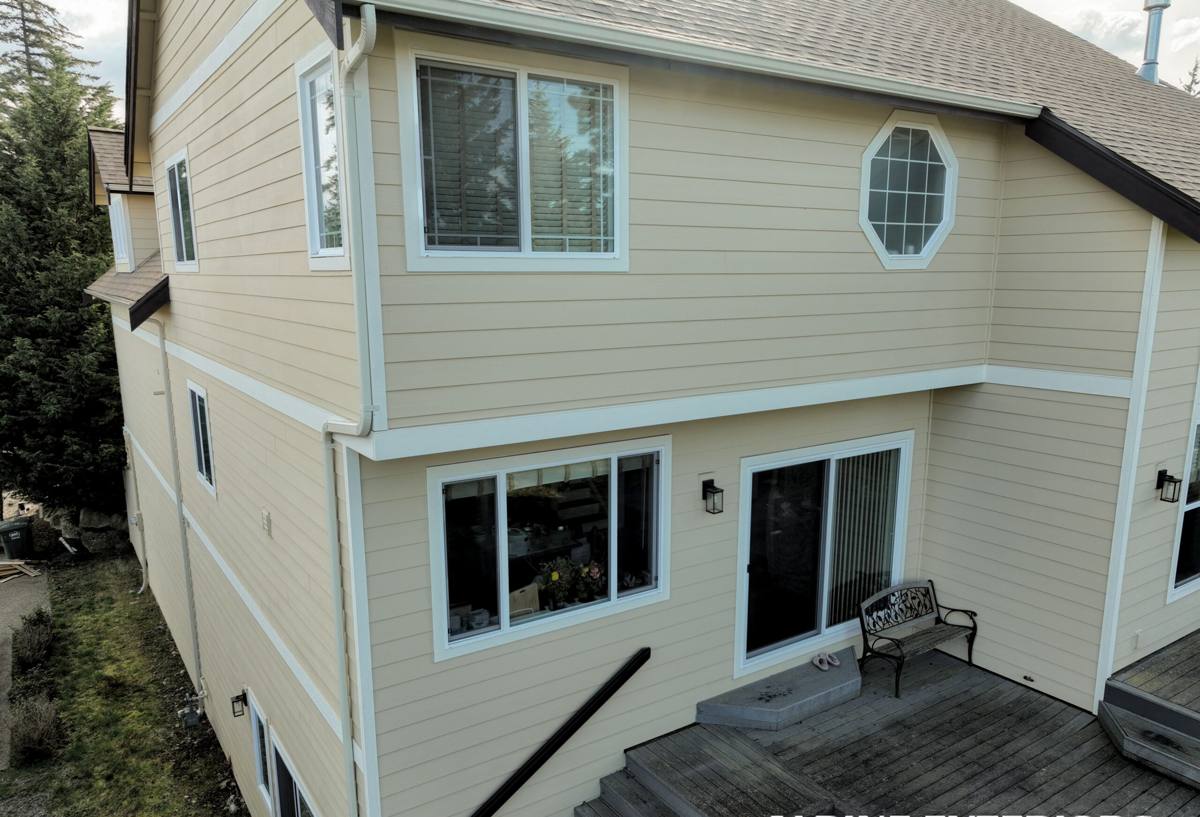
Choosing Decking Material for a Shaded, Wet Lot
Material choice matters more here than on a full-sun lot in town. Some products that perform fine in direct sun struggle in constant shade because they never fully dry between rain events. We walk every Deming property and factor in canopy cover, slope, and how close the deck sits to grade before recommending a material — not just what's popular that year.
| Material | How it handles shade & moisture | Maintenance demand |
|---|---|---|
| Pressure-treated lumber | Needs airflow and regular sealing to shed water in shaded areas; prone to moss without upkeep | High — annual cleaning and re-sealing |
| Cedar | Naturally rot-resistant and handles damp shade better than pine, but still greys and needs oiling | Moderate — periodic cleaning and oil |
| Composite (capped) | Doesn't absorb water like wood, but can still grow surface algae in constant shade if not rinsed | Low — occasional washing |
| PVC decking | Fully moisture-resistant; best option for deep-shade, heavy-moss lots | Low — rinse and go |
None of these choices is automatically "right" — a cedar deck on a Deming lot with good afternoon light can look great for years with basic care, while the same cedar in deep, constant shade will demand more attention than most owners want to give it. We lay out the real trade-offs rather than steering every job toward the highest-margin product.
What a Correctly Built Deck Involves
A deck that's going to hold up on a wet, shaded Deming lot depends on details that don't show up in a photo. These are the ones we don't skip:
- Footings sized and set below frost depth, on undisturbed or properly compacted soil — not resting on organic material that will settle
- Ledger board attachment with proper flashing so water is directed away from the house rim joist, not into it
- Joist spacing matched to the actual decking product, since composite and PVC often require tighter spans than solid wood
- Gaps and fastening patterns that allow the deck surface to drain and dry rather than trap standing water
- Ventilation and clearance underneath the deck so the substructure can dry out between rain events instead of sitting damp for weeks
- Corrosion-resistant fasteners and hardware rated for wet, high-humidity exposure — not just standard exterior-grade
Skip any one of these and the deck may still look fine on the day it's finished. The problems — soft ledger framing, sagging joists, moss creeping up from a shaded understructure — usually show up two to five years later, after the workmanship guarantee (if there ever was one) has expired.
Why Substructure Airflow Matters More Here
On a sunny, open lot, a deck's underside gets some indirect drying even with tight clearance. On a shaded Deming property, that same tight clearance can turn the space under the deck into a permanently damp pocket — which is exactly where moss and mildew get started before they ever reach the visible surface. We build in real clearance and, where grade allows, cross-ventilation, rather than treating underside airflow as an afterthought.
Our Process, Start to Finish
Every Deming deck project follows the same sequence, whether it's a small platform off a back door or a full multi-level outdoor living space:
- Site walk and design conversation — we look at sun exposure, tree cover, drainage patterns, and how the space will actually be used before drawing anything
- Material and layout selection — matched to the shade and moisture profile of that specific lot, not a one-size-fits-all package
- Permit prep — Whatcom County requires permits for most new decks above a certain height or attached to the home; we handle the application and inspection scheduling
- Footings and framing — built to code depth and spacing, with flashing and fastener choices suited to a wet climate
- Decking installation — spacing and fastening set for the chosen material's expansion and drainage needs
- Final walkthrough — we go over care and maintenance specific to the material and the shade level of that particular yard
Moss and Drainage: Designed Out, Not Scrubbed Off
Most moss problems on decks aren't a cleaning failure — they're a design failure. If water has nowhere to go and the surface never gets enough light or airflow to dry, moss will come back within a season no matter how often it's pressure-washed off. On Deming properties with heavy canopy, we pay particular attention to deck orientation relative to what sun does reach the lot, gap spacing between boards, and grading beneath the deck so water sheds away from the structure instead of pooling under it. A deck designed this way still needs periodic cleaning, but it won't need constant fighting just to stay usable.
Permits and Local Considerations
Whatcom County building permits typically apply to decks attached to the home or built above a certain height off grade, and setback requirements can vary depending on how close the lot sits to the river or to property lines. Because Deming properties are often larger and more wooded than in-town Lynden lots, septic system locations, well setbacks, and tree removal rules can also come into play in ways they wouldn't on a standard city lot. We handle the permit application and inspection scheduling as part of the job, so it isn't something the homeowner has to sort out alone.
Deck Maintenance for a Deming Property
Regardless of material, a few habits make the biggest difference in how long a deck stays solid and safe in this climate:
- Sweep leaves and needles off the surface regularly, especially in fall — trapped organic debris holds moisture against the boards
- Rinse or lightly scrub visible moss or algae before it spreads, rather than waiting for annual cleaning
- Check that gaps between boards haven't filled with debris that blocks drainage
- Inspect ledger board flashing and fastener condition once a year, particularly after a hard winter
- Keep gutters and downspouts near the deck clear so runoff isn't dumping extra water onto or under the structure
- Re-seal or re-oil wood decking on the schedule the material actually needs in shade — often shorter than the label suggests for full-sun installations
Cost Factors Homeowners Ask About
Every deck is priced around its own footprint, material, and site conditions, so we won't quote a number without seeing the lot — but these are the factors that move the price up or down on a typical Deming project:
| Factor | Why it affects cost |
|---|---|
| Height off grade | Taller decks need engineered footings, railings, and often stairs |
| Material | Pressure-treated lumber costs less upfront; composite and PVC cost more but need less upkeep |
| Access and slope | Wooded or sloped Deming lots can require more excavation and hand-digging for footings |
| Drainage work | Grading and underside ventilation add labor but prevent moss and rot problems later |
| Permit and inspection scope | Larger or attached decks require more formal plan review and multiple inspections |
Why Hire a Crew That Already Works in Deming
A contractor who only builds decks on open, sunny lots in town can still do solid framing — but they may not think through what constant shade and river-valley humidity do to a deck over time. We work throughout Whatcom County, including the wooded, shaded lots common around Deming, and we design around that reality instead of applying a standard spec sheet regardless of site conditions. That means fewer surprises: no moss creeping back every spring, no soft spots showing up where the ledger meets the house, and no guessing about whether the material we recommended was ever suited to the lot in the first place.
If you're planning a new deck or replacing one that's struggling with moss, soft boards, or standing water underneath, we'd be glad to walk the site with you. Reach out for a free, no-pressure estimate — we'll look at your specific yard, sun exposure, and drainage before recommending anything.