 Lynden Window
 Decking in Aldergrove, BC Has to Answer to the Weather First
Aldergrove sits in that stretch of the Fraser Valley and Whatcom border country where the weather doesn't really give a deck a break. The air carries salt and moisture off the nearby coastline, the rain comes in sideways more often than straight down, and there's a long stretch of the year — late fall through early spring — when a north-facing or shaded deck barely dries out between storms. That combination is exactly what wears decking out early: not one big event, but months of surfaces staying damp, framing staying wet, and moss finding a foothold anywhere the sun doesn't reach.
Composite decking is often sold as the fix for all of that, and in the right build it is a real improvement. But composite boards don't change the fact that water still has to go somewhere. A composite deck built without the moisture management this climate demands will look fine for a season or two and then start showing the same problems as a poorly built wood deck — just with different symptoms.
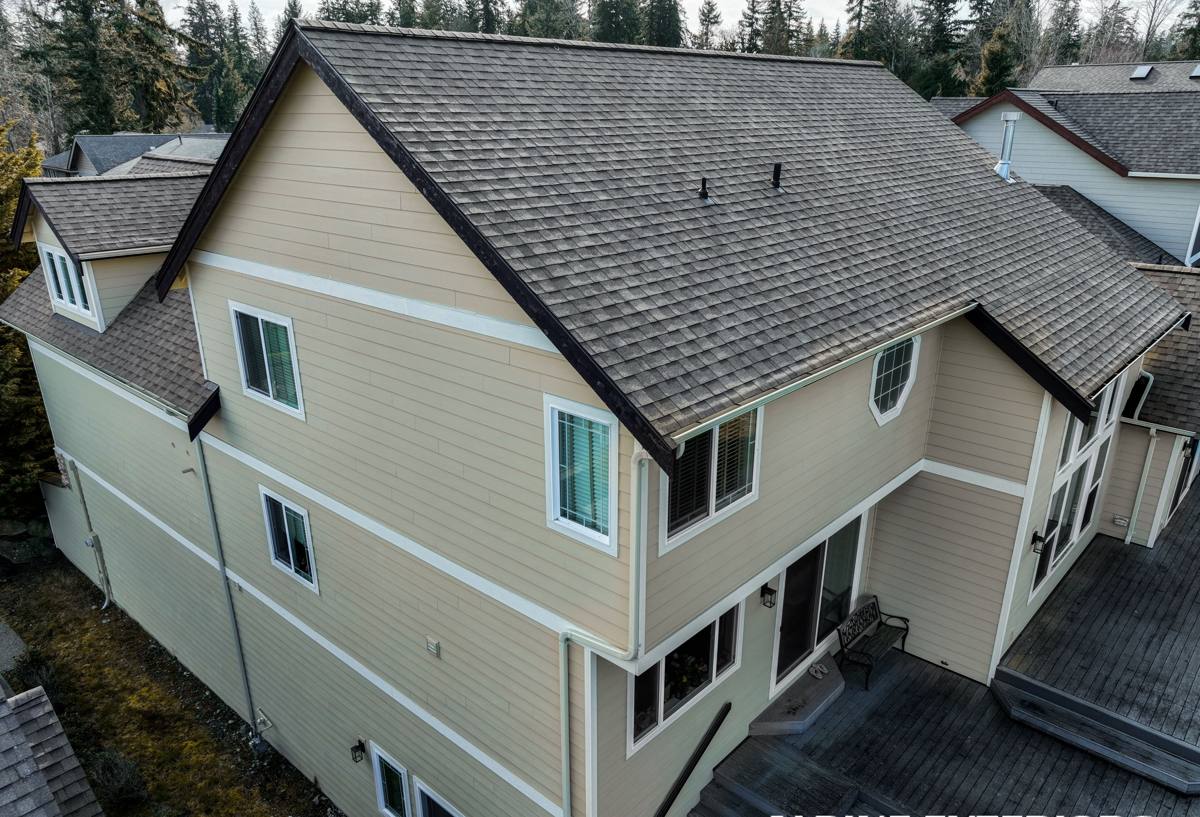
Why Composite Makes Sense Here — and Where It Still Falls Short
Moisture and Rot
Wood decking in this climate needs to be sealed or stained on a real schedule, and even then, end grain, fastener holes, and ground-contact posts are constantly absorbing moisture during the wet months. Skip a year of maintenance and you start seeing soft spots, splitting, and gray, weathered boards. Capped composite decking doesn't absorb water the way wood does, so it holds up through a wet Pacific Northwest winter with far less upkeep.
Moss and Algae
The tradeoff is that composite's smooth, moisture-resistant surface still grows moss and algae if it stays damp and shaded — the material doesn't rot, but organic growth doesn't care what it's growing on. A deck tucked under trees or against a shaded side of the house will need periodic cleaning no matter what decking product is used.
What Composite Doesn't Fix
None of composite decking's advantages matter if the structure underneath is built wrong. A capped composite board over a substructure with no drainage path just traps moisture against the framing instead of the boards — and rot in the joists and ledger is a much bigger repair than rot in the deck boards themselves. This is our standard for why we won't cut corners on the substructure: composite decking is only as good as what's underneath it.
What a Correct Composite Deck Build Requires in This Area
Substructure and Spacing
Joists need to be sized and spaced for the specific composite product being installed — composite spans differently than wood, and manufacturer spacing tables exist for a reason. Joist tape over the framing keeps standing water from soaking into the wood joists, which matters more here than in a drier climate.
Fasteners and Hardware
In a salt-air, high-humidity environment, the wrong fastener corrodes and stains the decking around it within a couple of seasons. Stainless steel or coated fasteners rated for this kind of exposure cost a little more up front and save a callback down the road.
Drainage and Airflow Underneath
Low decks with poor ventilation underneath are the most common failure point we see in this area. Water needs a way to drain off the surface and a way to evaporate from underneath — both matter equally in a climate where the ground rarely dries out completely between fall and spring.
Ledger Attachment and Flashing
Where the deck attaches to the house is the highest-risk point for water intrusion into the structure itself. Proper flashing at the ledger board is non-negotiable, regardless of what decking material sits on top of it.
- Joist spacing matched to the specific composite board's span rating
- Joist tape or an equivalent moisture barrier on all structural framing
- Stainless or coated fasteners rated for coastal, high-humidity exposure
- Proper ledger flashing where the deck meets the house
- Slope and gap spacing that lets water shed off the surface
- Enough clearance and venting underneath for airflow, especially on low decks
- Expansion gaps sized for the temperature swings this area actually sees
Composite Decking Options and What Drives the Cost
Not all composite decking is built the same way, and the differences matter more in a wet climate than a dry one. The table below is a general guide — exact pricing depends on deck size, height, railing choice, and site access, which is why we walk every job before quoting.
| Board Type | General Cost Tier | Moisture Performance | Maintenance |
|---|---|---|---|
| Uncapped composite | Lowest | Fair — the surface can absorb moisture over time | Occasional cleaning; watch for fading and staining |
| Capped composite | Mid-range | Good — the protective shell resists moisture and staining | Periodic wash-down for moss and algae in shaded areas |
| Premium capped / PVC decking | Highest | Very good — dense, low-absorption surface | Least upkeep; best fit for shaded or low-airflow decks |
For most homes in this area, capped composite is the practical middle ground — uncapped versions save money upfront but ask more of the homeowner in a climate that doesn't dry out quickly. Where a deck sits low, shaded, or under trees, spending up for a denser capped or PVC product is usually worth it.
Serving Aldergrove, BC From Just Across the Border
Lynden and Aldergrove sit on either side of one of the more direct border crossings in this part of Whatcom County, and we treat that as a logistics detail to plan around, not an obstacle. Jobs on the BC side mean building the crossing into the schedule — material deliveries, crew timing, and coordinating around wait times — so the work happens on the day it's supposed to instead of losing hours to a line that wasn't accounted for.
A crew that hasn't worked the area before is often figuring that logistics piece out for the first time on your job. We'd rather you not be the one paying for that learning curve. Beyond logistics, working this area regularly also means we've seen how the local mix of rural acreages, mature trees, and open exposure to weather actually plays out on decks over a few seasons — which shapes how we build for it from the start.
Our Process, Start to Finish
- Site visit and measurement — we look at sun and shade exposure, drainage, any existing structure, and how the deck ties into the house.
- Written estimate and product selection — we walk through board options and tradeoffs honestly, based on your deck's exposure and how much upkeep you want to take on.
- Scheduling around the weather window — we plan builds for stretches of the year that let framing and connections go in dry.
- Tear-out — if an old deck is coming out, we check the ledger and any posts for hidden rot before building new.
- Build — framing, flashing, and inspection points happen before a single board goes down, so nothing gets covered up that shouldn't be.
- Decking, fascia, and railing — installed to the manufacturer's spacing and fastening specs, not a generic standard.
- Final walk-through — we go over care and cleaning specific to your deck's exposure before we call the job done.
Keeping a Composite Deck Ahead of Moss in This Climate
Composite decking cuts down on maintenance; it doesn't eliminate it. In this area, a seasonal wash-down — typically once in spring and once in fall — keeps moss and algae from getting established on shaded boards. A soft-bristle brush and a mild cleaner made for composite surfaces is usually enough; a pressure washer on the wrong setting can scar the surface of some composite products, so it's worth checking the manufacturer's guidance first.
Beyond cleaning, keeping gutters and downspouts directing water away from the deck framing, and trimming back overhanging branches to let a shaded deck get some sun and airflow, does more for long-term performance than any cleaning product on the shelf.
Signs an Existing Deck Needs More Than a Cleaning
- Soft or spongy spots underfoot, especially near the house or stair stringers
- Boards that have cupped, warped, or separated at the fasteners
- Dark staining or discoloration that doesn't lift with a normal wash
- Any gap or movement where the deck meets the house at the ledger board
- Moss that regrows within a few weeks of cleaning, pointing to a drainage or airflow problem underneath rather than a dirty surface
Any of these usually means the issue is in the structure, not the surface — and that's worth a look before deciding between a repair and a full rebuild.
Straight Answers Before You Commit to a Deck
A deck is one of the few exterior projects where the mistakes hide underneath the finished product for years before they show up as a problem. That's true anywhere, but it's especially true in a climate that keeps framing damp for months at a time. The honest answer for most Aldergrove-area homes is that composite decking is a good long-term choice — as long as the build underneath it respects what this climate actually does to a structure.
If you're weighing a new composite deck, or wondering whether your current one is still sound, we're glad to take a look. The estimate is free, there's no pressure, and you'll get a straight answer about what your deck actually needs — just fill out the form below.