 Lynden Window
 Bellingham's Climate Is Rough on Siding
Bellingham sits where Puget Sound weather meets the foothills of the Cascades, and that combination is tougher on exterior cladding than most homeowners realize. Homes near Bellingham Bay deal with salt-laden air that accelerates corrosion on fasteners and finishes. Add in wind-driven rain off the water, long gray stretches where siding stays damp for days at a time, and a moss and algae season that can run eight or nine months out of the year, and you have a climate that punishes any siding product with a weak spot in its moisture management or finish system.
We install siding across Whatcom County, and Bellingham jobs consistently show the same failure patterns: paint that chalks and peels early, seams that swell, trim that rots from the inside out, and northern-exposure walls that stay green with moss no matter how often they're washed. None of that is inevitable. It's a product and installation problem, and it's fixable with the right material installed the right way.
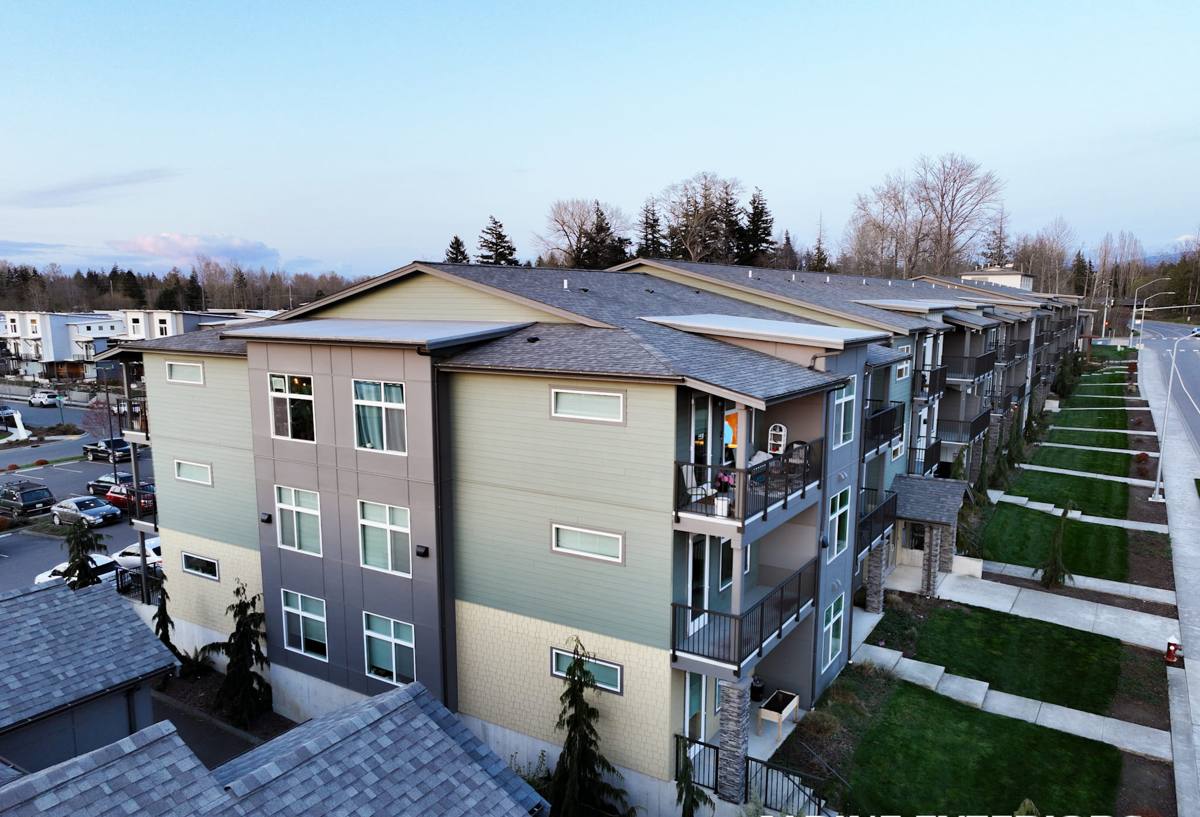
Why We Only Install James Hardie Fiber Cement
We are a James Hardie-only siding contractor. We do not install vinyl siding, LP SmartSide, Cemplank, Allura, primed spruce, or raw cedar. That is a deliberate standard, not a marketing line, and it is worth explaining honestly rather than just asserting it.
Vinyl
Vinyl is affordable and low-maintenance in mild climates, but it expands and contracts significantly with temperature swings, which means seams and panel edges can work loose over time. In driving rain it relies almost entirely on the water-resistive barrier behind it, since the panels themselves aren't a true water barrier. It also softens and can deform near heat sources, and its color is baked into a thin plastic layer that fades unevenly on sun-exposed walls.
LP SmartSide, Cemplank, and Allura
These are legitimate engineered products with real installers who do good work. Our concern is narrower: any wood-strand or fiber cement product depends heavily on getting every cut edge sealed, every fastener placed correctly, and every joint flashed to spec, because the failure mode when that discipline slips is moisture intrusion at the substrate — which in a climate as wet as Bellingham's shows up faster than it would somewhere dry. We'd rather standardize on one system we can install to the same exacting spec on every job than split our crew's expertise across several product lines with different tolerances.
Primed Spruce and Cedar
Real wood siding looks great and has genuine character, but it's the highest-maintenance option on this list. Primed spruce needs a finish coat soon after install and repainting on a real schedule. Cedar left natural will silver and take on moss in our climate faster than almost any other material, and stained cedar needs recoating every few years to hold its color and keep water out of the grain. In a region with our moss season and rainfall, wood siding is a genuine ongoing commitment, not a set-it-and-forget-it choice.
Why James Hardie
Fiber cement resists moisture intrusion by nature — it doesn't rot, and it's not a food source for the mold and moss that colonize wood and some composite products. James Hardie's ColorPlus factory finish is baked on in a controlled environment and backed by its own finish warranty, so you're not relying on field-applied paint holding up through a Whatcom County winter. Their HZ5 product line is engineered specifically for climates like ours — wet, moderate-temperature, high-moisture-exposure regions — with formulations tuned for that exposure. It's also non-combustible, which matters more each year as wildfire smoke and ember risk becomes a bigger part of Pacific Northwest summers. And the installed-correctly track record is long enough now that we know what it looks like decades out, not just on a spec sheet.
What a Correct Installation Actually Involves
Fiber cement siding is only as good as the installation behind it. James Hardie's own warranty terms depend on installation matching their specifications, and in a climate like Bellingham's the margin for error is smaller than in drier regions.
- A drainage plane and weather-resistive barrier installed continuously, with no gaps at penetrations
- A rain screen gap where wall assembly and exposure call for one, so bulk water and incidental moisture can drain and the wall can dry
- Correct fastener type, spacing, and embedment depth — under- or over-driven nails are one of the most common causes of early siding failure
- Factory-cut and field-cut edges properly sealed before installation, especially at butt joints
- Flashing at every window, door, and roofline transition, integrated with the barrier so water is directed out and down, never behind the siding
- Correct clearance from grade, decks, patios, and roof lines to keep the bottom edge of the siding out of standing water and splash-back
- Caulking and sealant used only where James Hardie's details call for it, not as a substitute for proper flashing
Every one of those steps matters more in a coastal, high-rainfall market than it does in a dry climate, because Bellingham weather doesn't give a wall assembly many chances to dry out between storms.
Our Process for Bellingham Homes
1. On-Site Assessment
We walk the exterior, check current siding and sheathing condition, look at drainage and grade around the foundation, and note wall orientations that see the most weather exposure — usually west- and southwest-facing walls that catch driving rain off the Sound.
2. Tear-Off and Substrate Check
Old siding comes off and we inspect the sheathing underneath. Any water damage, soft spots, or compromised framing gets addressed before anything new goes on — covering a bad substrate with new siding just hides the problem.
3. Barrier, Flashing, and Rain Screen
This is the step that determines how the wall performs for the next thirty-plus years. We install the water-resistive barrier, integrate flashing at every opening, and set up drainage per the wall assembly's needs.
4. Hardie Installation
Panels or planks go on to James Hardie's fastening and clearance specifications, with attention to color-matching ColorPlus panels and keeping reveals consistent.
5. Final Walkthrough
We inspect trim, caulking, and clearances, and walk the finished job with the homeowner before calling it done.
What Drives Cost on a Bellingham Siding Job
| Factor | Why It Matters Here |
|---|---|
| Home size and wall complexity | More corners, gables, and dormers mean more cuts, flashing details, and labor hours |
| Current siding removal | Multiple layers or damaged sheathing from past moisture intrusion add tear-off and repair time |
| Substrate repair | Rot or water damage found during tear-off, common on older Bellingham homes near the water or under heavy tree cover |
| Product line and finish | Plank profile, panel style, and ColorPlus color selection affect material cost |
| Trim and accessory work | Window and door trim, corner boards, and fascia detailing add scope beyond the field siding |
| Access and site conditions | Slopes, tight lot lines, and mature landscaping common in established Bellingham neighborhoods can affect staging and labor |
We give firm, itemized quotes after the on-site assessment rather than ballpark numbers over the phone, because the tear-off and substrate condition genuinely change the scope on older homes.
Maintenance and Longevity Through Moss Season
One of the practical advantages of fiber cement in a market like ours is how little it asks of you during Bellingham's long wet season. It won't feed mold or moss the way bare wood can, and the factory finish resists the chalking and peeling that plagues field-painted surfaces exposed to repeated wet-dry cycles. That said, no siding is maintenance-free here. We recommend periodic gentle washing to keep moss and organic growth from building up in shaded, low-airflow areas — north-facing walls and spots under tree cover especially — and a visual check of caulking and trim joints each year, since sealant is the one component that does age faster than the siding itself.
Signs Your Siding Needs Attention
- Visible moss or algae growth that returns quickly after cleaning
- Paint that's chalking, peeling, or fading unevenly, especially on sun- and rain-exposed walls
- Soft spots, warping, or bulging panels, particularly near the bottom courses or around windows
- Gaps opening up at seams, corners, or trim joints
- Rising interior humidity, musty smells, or peeling interior paint near exterior walls
- Siding that's original to a home built before better flashing and drainage practices were standard
Any one of these is worth a look before it becomes a substrate issue. Fiber cement doesn't rot, but the wall assembly behind old, failing siding can already be compromised by the time the exterior symptoms show up.
Why a Crew That Already Works Bellingham Matters
Bellingham and the broader Whatcom County market have their own permitting norms, inspection expectations, and weather-driven installation habits that don't always match how siding gets done in drier parts of the state. A crew that already works this area knows which wall orientations need extra flashing attention, understands local permitting timelines, and has already seen how different lots — waterfront, wooded, in-town — behave through a wet winter. That local repetition is what turns a correct installation on paper into one that actually holds up through Bellingham's weather year after year.
If you're planning a siding project in Bellingham, we're happy to take a look and walk you through what James Hardie siding would involve for your specific home. Fill out the form below for a free, no-pressure estimate.